





























- After years of restructuring and transformation, telcos are beginning to see progress in development of enterprise-focused revenue streams.
- CSG’s Greg Tilton believes a rethink on order fulfilment processes is now key to building B2B momentum.
- While generic configure, price, and quote solutions have proven inadequate for tackling proposition complexity, the SaaS platform provider considers its AI‑integrated, enterprise-oriented telco Quote & Order solution can bring flexibility, speed, and accuracy to the order process.
- Effectively deployed CPQ can meaningfully move the CFO dial through addressing revenue and profit leakage from unaccounted-for costs and services, as well as facilitating closing of more deals.
- CSG AI tools are easing complex integrations and paving the way for more autonomous fulfilment capabilities that make telcos hyper-responsive to enterprise customer needs, and well positioned to unlock growth from value‑add IT services.
The telco industry is finally beginning to see the benefits of years of digital transformation in B2B‑focused operations.

Unfortunately, when it comes to the commercially critical workflow of enterprise customer quoting and deal management, they remain “in a world of pain”, according to Greg Tilton, VP for Quote & Order at SaaS platform provider CSG, in discussion with TelcoTitans.
Financial structuring of B2B contracts has traditionally involved manual processes due to the complexity involved in creating detailed, intricate service agreements with multiple moving parts. The advent of configure, price, and quote (CPQ) systems, which came on the telco radar around 15 years ago, was expected to simplify and automate complex processes and shorten the timeline between quote and cash.
The sector’s journey with the technology has not proven to be a smooth one, however, and many implementations have failed to live up to the initial promise.
Tilton understands the disillusionment this has engendered, but also believes he knows what is at the heart of it, and how this can be addressed. “The foundations of too much telco CPQ remain generic, and that has held them back”, he explains, with many standard applications proving useful for consumer or SME uses, but not up to the job for enterprise.
This has led to many operators, which may now have implemented two, or even three, CPQ systems over this period, falling back on manual processes across the ordering process, particularly for higher-complexity, higher-value services.
“There’s a belief that enterprise pricing and quoting is an unsolvable problem still, because of that earlier experience. To prove otherwise can be a major undertaking.”
Tilton.
CSG is ready to put in this work, with Tilton arguing that tackling the need for greater automation in CPQ is not a challenge that can be avoided, especially as delivery of enterprise services is only likely to get more complicated and important as operators seek to drive B2B revenue growth through added-value services. The rise of AI increases this need to move faster.
Tilton also highlights the value of acting now, listing a series of benefits that come with an effective CPQ system, bringing flexibility, speed, and accuracy to the order process. These benefits have clear direct financial impact that can translate into gains of tens and even hundreds of millions of dollars for operators, and he has the case studies to prove this.
CSG: bringing telco sensibilities to CPQ
Tilton came to CSG in 2021 as the billing specialist acquired DGIT Systems, the company he founded and through which he developed the CPQ solutions that are now the foundation of CSG Quote & Order.
This telco‑focused CPQ came to market in 2018, built on the foundations of an information model that derives from TM Forum industry standards. Tilton highlights that DGIT had not only adopted open and interoperable standards as it developed its information model and services, but was also instrumental in developing TM Forum’s standards linked to the CPQ domain.
“We’ve made some pretty significant contributions into the TM Forum to further extend the standards as we’ve learnt different things about applying those industry standards in the CPQ domain. That’s then allowed us to build out a solution for that specific complex telco problem and our view is that you cannot solve it without being focused specifically on the problem.”
Tilton.
The earliest iterations of the solution focused on wholesale B2B telcos, before expanding to address the complexity of the telco enterprise space. Now as part of CSG as a larger group, investment in R&D has doubled with an intensified focus on the industry’s under-served enterprise requirement.
Described in the 2026 Gartner Magic Quadrant for CPQ as providing “the best solution evaluated in this report for the complex requirements of B2B telecommunications providers”, CSG is increasingly recognised as a leading solution provider in this sphere, with revenues rising on the back of sustained innovation.
The multi‑million dollar cost of pricing guesswork
For many telcos, Tilton considers inaccurate quoting to be a source of significant revenue and margin leakage.
Underlying costs are often much higher than anticipated in commercial agreements when elements of a solution are not fully configured. “Too often, there’s too much simplification, and a risk that a quote is based on a guess”, he warns. Problems with a quote can be exacerbated when changes are made during the quoting and fulfilment cycles, which have a meaningful knock‑on effect and leave telcos having to absorb increased delivery costs.
“We’ve seen some pretty big examples where tens of millions of dollars of revenue have been lost through the cycle.”
Tilton.
The revenue boost from addressing these leaks can in some instances be large enough to justify the entire business case for deploying telco‑focused CPQ.
In one example, CSG is instrumental in a transformation programme at a tier-one European operator where savings of €200m are targeted solely from flow-through fulfilment that starts with accurate configuration, quoting, and ordering at the business layer, and includes flow-through to network management.
Revenue leakage is a little discussed or acknowledged problem across the telco sector that can lie undiscovered for a long time.
Tilton highlights how an audit of an Australian operator by KPMG identified AUD $30m ($20m) in unbilled services that had arisen from changes made during the fulfilment cycle that were not agreed and recognised on commercial terms. “We were able to completely close that off for them”, he says.
“We are able to close gaps between the commercial agreement and service delivery, and give the transparency that operators need to ensure that each deal that they do is profitable.”
Tilton.
Re-assuring the CFO when complex deals inevitably evolve
Getting to a position where an operator has an effective structure on quoting can also deliver clear benefits for the finance function, according to Tilton.
Changes to contracts involving complex networks and solutions for sophisticated enterprises are inevitable, and providing transparency has significant value. A CPQ system that brings a greater level of clarity on evolving contracts also supports clearer final terms and smoother sign-off.
“When you have an understanding not just of the ‘price’, but also the underlying ‘cost’ of a contract, you have absolute margin transparency that can be validated.”
Tilton.
CSG provides a way to manage approvals using structured data, which minimises the need for coding and opens the way for telcos to simply revise parameters around deal clearance or levels of approval needed to ensure that oversight meets business needs.
“Any sort of discounting may go through an approval process that can be triggered by a number of parameters. The most common one is margin, and if the margin falls below a certain level, approval may be escalated, and often at the highest levels of discount it’s going to the CFO themselves to sign off. We can really put them in control.”
Tilton.
Finance teams appreciate the speed an effective CPQ can bring to the order process. “If you can accurately configure a quote, then you can drive your fulfilment processes end‑to‑end, and that integrity translates into being able to get a quote out the door very quickly”, he says. This responsiveness can also have significant uplift on the likelihood that a prospective client will sign on the line.
Tilton is acutely aware of the challenge of managing legacy systems and ‘tech debt’ within the telco sector. While he advocates for the benefits of significant change within the business layer, he further highlights how CSG solutions can work with, and help manage, the lifecycle of different generations of networks and systems already in place. This enables operators to modernise fulfilment while still leveraging prior investment.
“Operators often have different generations of network equipment and different operational systems on top of each of these different generations. Now, if an operator can expose the services that they deliver on each respective generation of equipment through northbound APIs, then CSG can provide a business layer to pull it all together… You don’t necessarily need to replace the systems that are directly managing the network, and we’ve got a whole lot of capabilities that make that a reality.”
Tilton.
Managing quoting complexity at multinational scale
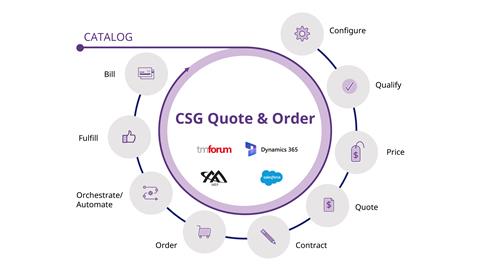
Tilton emphasises that for a CPQ system to be truly effective in a telco enterprise market it needs to be heavily catalog‑driven, with close integration of appropriate product listings. To illustrate this, Tilton says “there’s probably no better example than a multinational tier-one enterprise telco”. For a telco seeking to capture the benefits of having standardised products across all markets, and being able to promise the same service across all geographies, the challenges below the surface are considerable. Considerations can start with network topology and commercial relationships, expanding into managing multiple geographies and currencies. These lead into different cost centres, and across operating companies with local variations in equipment, partners and product features. Plus vagaries of regulatory requirements across borders. These often feed into a single quote.
“Quote & Order can actually inject those nuances into the process. You can essentially drive all the different layers of offer availability through a powerful catalog, and then solve the multinational enterprise problem.”
Tilton.
M&A can mean portfolio consolidation (and simpler means smarter)
Telcos often evolve through mergers and acquisitions, further increasing the complexity of internal systems and leading to product portfolios sprawled across the customer base.
This presents a significant obstacle to creating a manageable catalog that facilitates smooth enterprise order management and fulfilment, but also one that Tilton asserts can be addressed through the right CPQ system.
Tilton references Australian fibre operator Vocus, which came together through acquisitions of 15 businesses that had in turn also been built up through earlier acquisitions. This led to a scenario where there were 60,000 products available at the time a CSG solution was onboarded.
To create a viable catalog that is compatible with Vocus’s new CPQ system from day one, the operator undertook a major discovery and rationalisation exercise that reduced the total to just 208 products. Tilton stresses that this was not just a rationalisation exercise taking out operational cost, but also opened future optionality within the portfolio.
The CSG catalog‑driven approach features multiple configurable elements within a product that are related to different levels of functionality and involves a “looser coupling between the product and the price”. With pricing that flexes based on how the product is configured, Tilton says operators can offer “a smarter product” minimising the need for — and costs related to — a larger portfolio that is less flexible and less responsive to changes in customer requirements.
“When you’re not terminating a product and replacing it with another to meet a new customer requirement, but instead just changing the configuration of the product they’ve got, you make it way easier to manage change going forward. Telcos can get a lot of cost out of their business with this sort of product simplification.”
Tilton.
CPQ done right: springboard to value-added services growth
Tilton sees a huge opportunity for operators in the B2B sector that can be tapped into should they successfully address challenges around constructing and fulfilling offers.
He cites cybersecurity, managed Wi‑Fi services, SaaS, and IoT as among the areas that interplay with underlying connectivity and can be integrated into telco offerings more simply with the right CPQ system in place. “Having it all as part of the offer, and having all those dependencies managed in the way it’s fulfilled, is a really big opportunity for telcos to mean a lot more than just ‘connectivity’ for B2B”, he asserts.
Tilton’s ambitions for what operators could be doing for enterprise customers is considerable. “There is a lot of potential for a telco once they solve that foundational problem of being able to put out connectivity solutions really seamlessly across all of their markets”, he says, with services then able to be enriched with IT-value.
“I think the objective of a telco should be to get their enterprise customers to the point where they don’t need an IT department. The telcos have got the opportunity to eat a lot of IT’s lunch and grow their enterprise businesses.”
Tilton.
From rapid out-of-the-box ignition to tailored outcomes
When CSG works with an operator on implementing CPQ, phase one involves delivering what Tilton sees as essentially an out‑of‑the‑box version of the Quote & Order solution.
This has a “very short path to a working system”, he says, featuring early workshopping, deployment of pre‑configured elements and customer‑led refinements. “It’s much easier for a telco to provide clarity on their requirements when they have a system working in front of them”, he explains.
Adapting the system is then configuration‑based, and integration with other systems is managed through a suite of TM Forum‑certified APIs that help significantly simplify the process.
Topics
- AI/GenAI/ML (artificial intelligence, agentic, machine learning)
- API
- Australia
- Billing (charging)
- Catalogue
- CSG International
- DGIT Systems
- Digital transformation
- Digitalisation
- Enterprise (B2B)
- Europe
- Financial & Performance
- Greg Tilton
- Interview
- KPMG
- Operations
- Products & Services
- Standards
- Strategy & Change
- Suppliers & SCM
- Thought Leadership
- TM Forum (TMF)