
















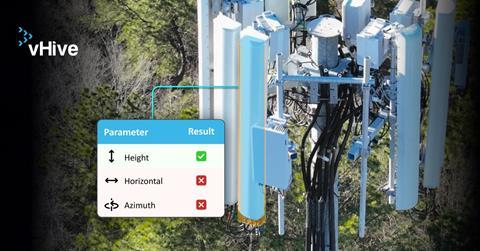
- vHive’s latest On‑Site Validation combines autonomous drones, digital twins and AR overlays — working in real-time to close the chasm between network design plans and physical reality.
- Data from early deployments shows frequent and major mismatches in antenna azimuth, tilt and height.
- The solution identifies actionable opportunities to improve network performance, customer experience and operational efficiency.
- By embedding validation into existing workflows and drone inspections, vHive seeks to cut contractor revisits, re‑work and billing disputes while accelerating activations and revenue recognition.
- The innovation is positioned as a trust engine for an “ecosystem of bliss”, giving MNOs, towercos and contractors a shared, verifiable view of what is actually installed.
- Continuously updated, site‑level digital records also support governance, regulatory compliance, and M&A due diligence by creating a “ready‑for‑audit” asset environment.
- vHive’s CTO frames bidirectional data flows between digital twins and field execution as a structural shift in how telecoms infrastructure assets will be managed in future.
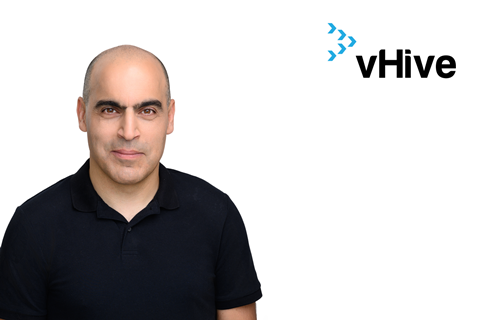
A self-confessed “geek”, vHive’s co-founder and CTO Tomer Daniel can trace his enthusiasm for technology back to a Commodore 64 microcomputer when he was an eleven-year-old.
Speaking to TelcoTitans on the launch of the telecoms digitisation leader’s new On-Site Validation solution, he said he has ever since felt that, “I love software that connects between the physical, the virtual and the digital… It’s like magic — you say something and something happens in real life”.
This passion led him to a career in software and telecoms, and ultimately the founding of vHive alongside CEO Yariv Geller, where the pair work on transforming the physical (network) into the virtual (digital twin), and now also ensuring these remain in sync.
vHive’s early successes with towercos and network operators stemmed from bringing two elements together in its solution: the autonomous acquisition of field data (such as cellular radio site configuration), and the application of digital twin technology (to bring that real-world data into the digital domain).
The platform enables customers in the telecoms infrastructure sector to digitise a site before any physical changes are made, leveraging digital twins to provide a model that can be used for engineering and to create an ecosystem-wide service provider and client “single source of truth” for network assets.
Now, with its industry-first On-Site Validation, vHive aims to close the gap between network planning and what is actually deployed in the field, improving accuracy, timeliness, and confidence in how site changes are captured and verified. Daniel says vHive is achieving this by going beyond just bringing the physical world into a digital platform, though now expanding this capability to take digitisation back into the physical world.
“The industry has matured to the point where we can finally ask a new question: ‘what more can we do with all the [digitised] information we’ve already delivered?’ On-Site Validation enables that next step; going back to the field to reconnect digital data with the physical world. ”
Daniel.
The need for such a solution may be greater than many in the industry recognise, with the vHive CTO believing there is silent acceptance of what can be a large gulf between network plans and network reality.
The costs of continuing to accept this gap are simply too big to continue ignoring, he believes, whether from a network performance, customer experience, or operational efficiency perspective.
Green means go
When On-Site Validation is in action, vHive’s CTO explains that a rapid autonomous drone survey is undertaken immediately after the contractor has completed work at a site, focused in real-time on aspects where changes have been made.
Once captured, the system instantly sends a report to both the contractor and the commissioner of the work, providing a green or red assessment indicator. Green means work matches expectations and the contractor can move on, red that there are discrepancies to be addressed before the contractor departs the site.
Seismic disconnect between planning and reality
A major challenge facing the telecoms ecosystem is the difference between what the network looks like in theory, and the real-world reality. This poses difficulties not just for MNOs and towercos, but also for the general contractors responsible for field deployment and ongoing network support.
The challenges in establishing a clear picture of the intricacies of deployed infrastructure are considerable, but Daniel highlights that when vHive starts to provide data to customers the discrepancies between digital reference and physical reality can quickly become startlingly clear.
vHive’s data demonstrates that it is not unusual to find major differences across deployments. Based on multiple customer results, the following types of mismatches are commonly observed:
- Antenna azimuth — the horizontal angle at which an antenna points relative to a fixed reference could be beyond an operator’s levels of built-in tolerance approaching 35% of the time.
- Antenna angle of tilt can be beyond tolerance over 25% of the time.
- Equipment height can be out of range even more often, with Daniel citing instances of sub-optimal positioning as much as half the time.
The consequences of not addressing this disconnect are clearly substantial, but can also snowball when misguided central network assumptions are being used as the basis for future development. This, vHive asserts, can trigger “the costliest chain reaction in telecom infrastructure” for all involved, through: a series of revisits; re-work orders; billing disputes; delayed activation; and slowed revenue recognition.
“If you want to make a change, you start with a plan, but the risk is your plan is going to be based on wrong information. It may be a perfect plan, but it’s a plan for another reality.”
Daniel.
Having an unaligned plan can mean that general contractors are immediately faced with tough decisions when visiting sites and finding mismatches. “When the gap between the plan and the reality becomes clear, they can either say ‘I can’t do it today’, and leave, or complete the construction but not according to the plan”, explains Daniel, “Neither choice is good for anyone because you’re choosing between two types of ‘wrong’”.
Operators are then left in a situation where they “keep thinking they know what’s going on, but customers are going to complain over coverage”, says the vHive CTO. They may believe that coverage problems are resolved because they have commissioned field activity to address the issue, but in actuality the deployment is either compromised or did not happen at all, and “either way leads to poor network coverage”.
The problem has been heightened with 4G and continued rollout of 5G both “demanding large-scale installations, and very, very high accuracy”. Future network evolutions look set to continue this trend.
“You have to be more accurate. You have to be more efficient. You can’t roll out on that scale and accept misplacement in height, tilt, or azimuth. It’s going to quickly cascade into performance issues and costly rework”, Daniel warns.
The answer, he believes, comes with another emerging technology that the CTO considers perfectly suited to the demands of unifying digital plans with physical reality.
Delivering AR that’s a tool, not a gimmick
vHive’s On-Site Validation solution addresses a major pain point for network operators: speeding up the time it takes to confirm that site work was completed correctly and according to plan.
For vHive’s customers, Daniel says the ideal is that any contractor will be able to know, before leaving the site, that the installation meets the requirements and specifications of the operator or towerco plan.
This led vHive to work on developing a solution where “we could give a clear ‘go/no-go’ to the contractor at the scene”, with the company turning to augmented reality (AR) to enable real-time review of installation and confirm that all changes made on-site match digital twins and plans.
This approach, the CTO says, is accessible and supportable to all involved because “it fits within current processes”. The equipment required is essentially already used for site surveys and installations and does not rely on specialist hardware. “All you need is the screen on the remote control of your drone, showing the live feed, and on top of it, the plan”, he explains, and “you’re looking at the screen you would be looking at anyway”.
“The process was always to send the plan to the contractor, who then confirms the job was completed as expected. We’re just providing more information beforehand and more information at the end of it.”
Daniel.
This not only provides greater certainty to the operative on-site but also supports the contractor’s wider needs, giving confidence to go to the next site instead of having to just hope they have completed the job properly while risking time and cost of a return visit.
“It’s the same workflow, but it’s cheaper: it’s more accurate, it’s faster, it’s automated, so it is better for everyone involved. It’s a win-win.”
Daniel.
Daniel flags that another benefit of working within existing workflows is that a deployment does not require significant additional budget, and may indeed enable savings within existing expenditure plans. “The technology pays for itself”, he declares.
After demonstrating On-Site Validation for a prospective client, Daniel recalls being “pulled to one side and quietly told, ‘this is the first time I’ve seen AR used as something that has value and isn’t just a gimmick”.
This application of AR for demonstrable benefit delights Daniel, who says that, “from a technology perspective, I’m happy to provide something that is cutting edge, but it’s even better when it provides real value to the customer and addresses a pain point for them”.
Benefits built on trust, fostering an “ecosystem of bliss”
Through On-Site Validation deployments, Daniel says MNOs are “happy to be accelerating rollout timelines, and ensuring everything runs smoothly”.
“Once construction is signed off, the operator knows the installation meets specifications and no longer has to question whether network performance will match what was planned.”
Daniel.
He now envisages wider-reaching collaboration and ecosystem benefits colourfully described as “an ecosystem of bliss”, whereby towercos, operators and contractors are able to work together more effectively. “Everybody is happy, everybody is getting more efficient, everybody is arguing with each other less”, he envisages, “It’s something that is beneficial for the whole ecosystem, not just part of it”.
For general contractors, Daniel says the advantages of On-Site Validation are manifold and being welcomed from a professional perspective.
Firstly, the guesswork in any deployment is removed: “they get the plan, and they can trust the plan”. For contractors, “this has really reduced the number of callbacks and site revisits, which is an important benefit for professional contractors”. Then, with validation providing instant approval of work, contractors are able to invoice faster and more accurately.
Towercos are benefitting from greater clarity and understanding of what is being done at their sites. vHive’s solution ensures there are no gaps in knowledge, such as when work on site diverges from, or is additional to, what was initially shared. “For infracos, this means faster monetisation”, explains Daniel, “They know exactly what’s happening on the tower and there’s less scope for disputes”.
The CTO emphasises the value of this mutual transparency in easing the risk of friction between partners, and as a foundation for greater trust.
“When everything works better, we trust each other more — like I said, it’s about ecosystem bliss!”
Daniel.
Creating a “ready-for-audit” environment
Delivering an up-to-date and accurate picture of infrastructure sites also has powerful benefits when it comes to governance, according to Daniel.
Contractual and public responsibilities for towercos include managing emissions and ensuring equipment is properly installed in terms of height and weight, and being able to prove compliance is critical. Operators, meanwhile, have coverage obligations, and confidence that these are being met is valuable.
“Operators don’t need to doubt network performance, in terms of what has been installed. If a problem comes up, the first step no longer needs to be sending someone to climb the tower. Once they have trust in their infrastructure, they can make better decisions and don’t have to start guessing.”
Daniel.
Regulatory obligations can be at the forefront of concerns in Europe, in particular, and Daniel says clients in the region value being reassured of “ready-for-audit” status. “You can hear the sigh of relief when we tell them”, he says.
The benefits of an accurate and transparent record of the network environment also stretch to preparations for financial audits, due diligence, and M&A requirements.
Changing sector outlook on managing network infra
Daniel is certain that the prospect of better integrating the real and digital network worlds through information and insight that flows in both directions will fundamentally change the way infrastructure management is approached.
He sees the latest vHive platform development as creating trust on all sides — “This is a step forward for the industry that will propel everybody into an ecosystem based on efficiency and transparency that we’re just not used to at the moment”.
On-Site Validation is only the start of plans for bringing digital services into the field environment, Daniel says, with further ideas in the pipeline to leverage the potential of digital twins. This development, he stresses, is client-driven. “This is how the platform has always developed”, he guides, “we listen to our customers, understand their pain points, and always look for ways to help that will generate a return on their investment with us”.
“Once you start using digital data, getting informed decisions, and have that trust — from towercos, to operators, to general contractors — nobody wants to go back. At the end of the day, you have to use good data, and this is where the industry is headed.”
Daniel.