























- Despite providing foundational infrastructure for AI data flows, telcos are not capturing a proportionate share of the financial returns.
- Operators can establish a trusted role in the enterprise AI orchestration market by leveraging their infrastructure and strong B2B relationships as a sovereign alternative to hyperscalers.
- In conversations with TelcoTitans, Pardeep Kohli urges operators to look beyond the short‑term challenges of chip shortages and act now or be left behind — warning that “there’s a cost to doing nothing”.
- The Mavenir CEO notes that the cross‑industry impact of AI transformation leaves telcos with nowhere to hide, with boards benchmarking against multiple sectors on innovation.
- The telco‑first software provider is partnering Red Hat to deliver an enabling AI platform for operators.
Telecom operators are providing much of the infrastructure enabling the flow of data that is fuelling the growth of AI and related revenue streams.
Yet, as with earlier technology innovations facilitated by advances in connectivity infrastructure, telcos themselves are so far not seeing a significant share of financial returns flowing their way.
However, Pardeep Kohli, CEO of Mavenir, believes that the sector still has opportunity to drive a different outcome this time, with operators ideally placed to seize a key role in the AI value chain.
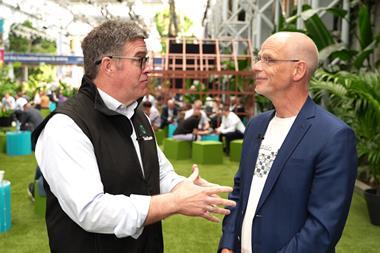
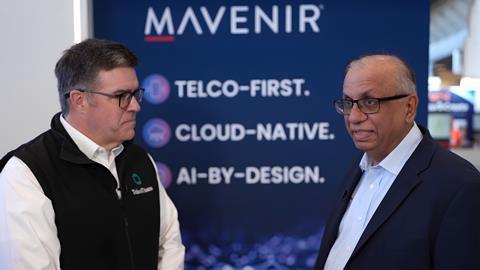
Speaking to TelcoTitans TV’s Matt Leary during and before this year’s TM Forum DTW Ignite conference in Copenhagen, he explains how the telecom network software vendor is positioning itself to support a telco AI charge and shares his vision of becoming a “Snowflake for telcos”.
“Telcos are different”, says Kohli, and “like any industry, you need to train your AI to match the requirements of the industry”.
Through creation of the Mavenir Integrated AI Platform, developed for operators in close collaboration with open-source cloud-native software provider Red Hat, Mavenir has created a pathway that can help telcos find a place in the AI ecosystem. Early proof points include T‑Mobile’s launch of a live in‑call translation service and Virgin Media O2’s cloud voice enhancement trial for hearing-impaired customers. In Germany, Mavenir is working with Telefónica in a joint AI Innovation Hub, as the pair also collaborate on migrating customers to a cloud‑based IMS architecture.
Kohli sees multiple routes for operators to stake their claim in the AI ecosystem, and is in discussions with operators he believes are ready to match his level of ambition.

We’re building the platform where they can run their own LLMs and, of course, build their own agents and run their own applications and have more control on what goes on in the network.
Cloud‑native duo Mavenir and Red Hat take the telco fight to hyperscalers
The Mavenir AI platform is pitched as a critical capability for operators seeking a route into sustainable AI‑based propositions.
Running services on top of AI hardware, whether an operator’s own resources or a hyperscaler’s, requires an environment that can effectively handle containerised cloud-native software, and Mavenir’s partnership with Red Hat brings this capability to telcos.
The enabling relationship goes back a long time, notes Kohli, who flags that his company was also a pioneer in running its entire telco network software portfolio in Red Hat’s Kubernetes technology platform, with the latest collaboration bringing together Mavenir AI software and Red Hat cloud-native and AI capabilities on validated third‑party hardware.
Now, an AI large language model (LLM) can simply become another containerised Kubernetes workload, with further optionality over processing capability from Nvidia or other suppliers, as part of an operator’s workflows.
A pivotal element of this set‑up is that it addresses a fundamental recurring challenge presented by the fast‑changing world of AI models, where LLMs are constantly evolving. Without a containerised environment “every time you take a new model, you forget what you did before and start all over again”, says Kohli, “we want to make sure that when a new LLM comes in, it is immediately trained on what we have already remembered from the past”.
Demand for an operator‑led AI solution is building, Kohli believes, resonating with views expressed elsewhere at DTW Ignite, where the TM Forum Chair Steffen Roehn highlighted telcos’ strength of relationships with enterprise as an opportunity for them to create a trusted layer for AI in the value chain.
“There will be a lot of enterprises that will trust an operator more than a hyperscaler for doing this type of task.”
Kohli.
Mavenir: enabling different attack vectors for telco AI
Mavenir has identified three telco AI operating models where it believes it can support operators in building a role in enterprise AI development that goes beyond providing a data connection and leads to clear monetisation opportunities.
-
Operator AI services — Mavenir suggests operators can build an orchestration layer providing enterprises with access to a range of large and small language models (some remote, some local), which is leveraged to direct AI queries from customers in the most efficient way. If queries are simple or, like translation services, capable of being delivered with a targeted specialist model, operators can build their own model to process these. More demanding requirements can still be routed to frontier models. “If it’s not a nuclear physics problem, why would you want to give it to someone else to solve?”, asks Kohli, “even if 40% of queries need to be addressed by other models, you’re still in the game”.
-
Enterprise AI platform — operators can opt not to develop their own end-to-end LLM play, and instead focus on providing the compute and connectivity infrastructure platform, with enterprise customers bringing their own AI solutions. Kohli suggests that most of the work would still be done by the operator as part of a premium managed service, enabling enterprise customers to have their own LLMs without having to majorly invest in hardware that it would likely be under-utilised.
-
AI grid infrastructure — the third scenario is creation of an AI grid, where operators exploit the extent of their network infrastructure and “proximity advantage” to distinguish between queries that benefit from low‑latency responsiveness and those that are less urgent, and route them accordingly. Kohli terms this as “load-balancing for queries”, to make operators part of the value chain.
Beyond RAMageddon: the time for operators to act on AI is now
Long‑simmering predictions of ‘RAMageddon’ memory shortages continue to materialise across the tech sector and beyond.
For telcos, this means the prospect of securing the necessary kit to make a mark on the AI landscape is limited, at least for the coming twelve months.
For Kohli, however, this does not mean that telcos should sit back and wait to see how the market develops before acting.
For operators with serious intent to pursue AI platform development, he believes they need to start now, and can initially build on hyperscaler assets before transitioning onto their own infrastructure when the supply chain permits — that way, “you can then move forward with it faster”.
Achieving an effective proposition integrated into operator systems and networks will also inevitably take time, with the Mavenir CEO warning there is “an opportunity cost to doing nothing”. Kohli also suggests telcos can start ‘at home’, before going ‘outside’.
“Looking ahead to this time next year, operators are starting to figure out how they can play in this space and this is what we are working with them on: let’s work together; let’s build that technology; let’s figure out how we’re going to do the LLM orchestration. Start using it for your own home usage first, and then you can take it outside.”
Kohli.
View from the boardroom may drive impetus for change
Kohli points to a notable distinction for operators between the consequence of today’s market shift caused by AI, and those linked to earlier generational shifts in network technology.
While operators may not have captured much of the significant wider economic value generated from their 2G to 5G mobile network evolutions and investments, this market dynamic was very specific to the industry, with all telcos in the same boat.
With AI, however, transformation is impacting every industry, so “now, there’ll be something to compare against”, he highlights. This means that impact can (and will) be compared to other sectors also wrestling with the opportunities and disruption that AI brings. For example, “if an old railway company can go faster than a telco company in AI adoption, you can now really compare that”, he says.
Along with investors and other significant stakeholders, telco boards are likely to give serious attention to just this sort of comparison. Independent directors often traverse multiple sectors so they may ask “why can’t I figure out how to run my network faster?”, if agents can be deployed effectively elsewhere. “If an industry doesn’t move as fast [as others], then it tells you that, okay, there’s definitely problem in the industry”, warns the Mavenir chief.
With boards and executive committees expecting action and results, Kohli emphasises the importance of operators acting now. Adopting AI for cost cutting may be an easy first step, but more is needed, and this is where Mavenir sees opportunity to provide telcos with the support that will enable change.
The European market also presents a particular opportunity, believes Kohli, where the sizing of individual countries and the growing emphasis on sovereignty creates an environment where the financial cost and business potential of transformation are more evenly balanced than elsewhere. “[Operators] have power, they have real estate, they have proximity to customers, they have data centres”, he says, but “what they don’t currently have is the stack which AI needs”.
“We provide that stack, we have been a partner for telco for many years, and we can help them make the transition.”
Kohli.
Topics
- AI/GenAI/ML (artificial intelligence, agentic, machine learning)
- Business/commercial model
- Cloud
- DTW Ignite (TM Forum)
- Enterprise (B2B)
- Europe
- Germany
- Hyperscalers vertical (webscale)
- Interview
- Matt Leary
- Mavenir
- MWC (GSMA Mobile World Congress)
- NVIDIA
- Pardeep Kohli
- Red Hat
- Snowflake
- Steffen Roehn
- Telco Cloud
- Telefónica Group
- Thought Leadership
- TM Forum (TMF)
- T-Mobile US (DTAG)
- Video Content
- Virgin Media O2 (VM O2)