
















- Agentic AI can deliver orchestrated and automated network operations, according to new Mobile Europe and Celfocus report.
- Live deployments already seen delivering significant benefits, including at BT, Deutsche Telekom, Orange, Telefónica, and Vodafone.
- Ten recommendations to help ensure successful deployment and ROI.
- Operators must focus on specific and clearly articulated problems at the outset, to build trust ahead of full strategic roll-out.

Agentic AI brings with it the promise of autonomous network operations (ANOps) with huge returns for telecoms operators. But the sobering reality for the telco sector and other industries is that 40% of enterprise AI projects will be cancelled by the end of 2027, according to analyst firm Gartner.
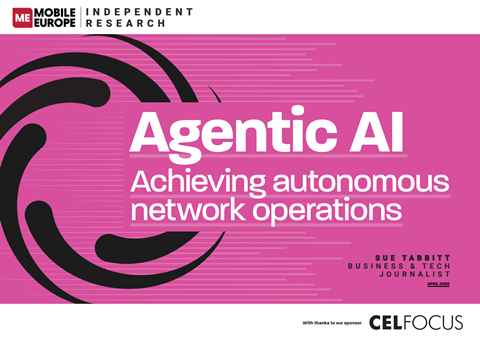
A new report by Mobile Europe, produced in partnership with European telecoms systems integrator Celfocus, explores how operators can successfully bridge “the autonomy chasm” to reach a Level 4 highly autonomous environment, as defined by TM Forum.
Early deployments across European operators are seen already delivering measurable results, with fault identification cut from hours to minutes, and significant reductions in tooling costs and field revisit rates.
Unlike conventional AI tools, agentic systems can set goals, plan actions, use tools, and adapt, without waiting to be told what to do next. Agentic AI will result in “orchestrated AI systems” which can “reason, plan and act autonomously across complex, multi-step workflows”.
The Mobile Europe report — Agentic AI: Achieving Autonomous Network Operations — also makes clear that operators “must be prepared for the long haul” with an initial focus on narrow and well-defined problems before strategic scale can be achieved.
“Successful deployment and real return on investment will require disciplined execution, grounded in operational and economic reality.”
Mobile Europe.
The automation ceiling — capturing the elusive final third of value
Most telecoms operators, under pressure to reduce costs and improve network quality, have already achieved some of the easier wins from automation.
Pre-agentic, rule-based systems handle predictable, repetitive tasks well, but they struggle in the dynamic, software-defined environments that 5G, open RAN, and cloud-native infrastructure have created.
According to Charlotte Patrick Research, roughly two-thirds of the available cost savings from automation have already been taken. Getting to the remaining third — the complex, context-dependent tasks — is the key to unlocking value and achieving ROI from ANOps.
Celfocus helps operators capture maximum value through a disciplined, engineering-driven approach, utilising a layered architecture with a structured, time-aware digital twin at its foundation. This digital twin provides AI agents with a precise, validated, and multi-vendor view of the network, enabling context-aware reasoning and safe execution.
By ensuring agents operate on accurate, queryable network models rather than just unstructured data, Celfocus helps operators avoid common pitfalls like hallucinations and context loss, making network autonomy fully auditable, predictable, and secure.
Where operators are focusing
The report includes examples of how operators are using agentic AI, including:
- BT’s focus on domain-specific – mobile, traditional voice and broadband – model training while leveraging cross-brand and cross-customer data in context.
- Deutsche Telekom’s RAN Guardian which monitors network parameters, predicts anomalies, and automates corrective actions in real time on live 5G networks.
- Orange’s multi-agent security system with monitoring, knowledge management, and response agents working in unison, leading to faster threat detection and mitigation.
- Telefónica’s deployment of customer-facing agents that handle call management and reduce escalations, while in B2B agents are being used for quote automation and fault resolution.
- Vodafone’s Field Technician Assist platform which gives engineers contextual briefings and troubleshooting guidance on-site, securing a 30% reduction in repeated site visits.
Recommendations for operators
The case studies evidence the potential for agentic AI in the telco industry, but there is work to be done to ensure widespread adoption.
The report emphasises the importance of human oversight to establish trust, a solid data foundation, security and governance, and realistic expectations for stakeholders.
Operators must manage this carefully and, initially, reserve full autonomous action for narrow, well-understood use cases where trust has been earned.
Among the conclusions is the importance of a solid foundation underpinned by a “high-fidelity, time-aware, multi-vendor digital twin” and “specialised-agent architecture with typed tools and a thought-through orchestrator”.
Celfocus is a leading telecoms SI in Europe, with longstanding depth and strength in data, analytics, and automation, including AI, digital twins, and telco cloud. Notable recent engagements around network autonomy include Liberty Global’s Telenet and Vodafone Group’s regional network operations centre, as well as contribution to Project Sylva.
Topics
- 5G
- AI/GenAI/ML (artificial intelligence, agentic, machine learning)
- Automation
- Autonomous networks (zero-touch)
- BT
- Celfocus (Novabase)
- Deutsche Telekom Group (DTAG)
- Digital twin
- Enterprise (B2B)
- Europe
- Financial & Performance
- Fixed broadband (FTTx)
- Network & Infrastructure
- Network Operations Centre (NOC)
- Open RAN (ORAN)
- Operations
- Orange
- Security
- Sustainability (ESG - environmental, social, and governance)
- Telefónica Group
- Thought Leadership
- TM Forum (TMF)
- Vodafone Group
- White Paper