













- Swisscom’s newly merged Italian OpCo is building a real-time network digital twin as foundation for reaching TM Forum Level 4 autonomy by 2030, assisted by systems integrator Celfocus.
- An AWS-powered digital twin is already modelling close to 100 million nodes and 120 million edge points, slashing change impact assessment time from 30 minutes to seconds.
- For root cause analysis, the target is an 85% cut in alarm noise, and 40% reduction in mean time to repair for remote fixes.
- Mario Volonterio, the operator’s Head of Digital Networks and AI, sets out lessons from the rollout, including the scale of internal data validation needed to earn engineers’ trust.
Two years ago, when the operators combined, Fastweb + Vodafone’s network operations were “pretty reactive” when it came to managing incidents, according to Mario Volonterio, the operator’s Head of Digital Networks and Artificial Intelligence.
He told delegates at DTW Ignite 2026 that this was the inevitable result of stitching together two rival systems, each running its own OSS/BSS stack. The challenge of merging these legacy estates was formidable.
Swisscom’s €8bn acquisition of Vodafone Italia closed in 2024, and the business was legally merged into the Swiss group’s local subsidiary Fastweb on 1 January 2026, leaving the combined operator managing around 110,000 pieces of physical equipment.
Rather than wait for physical consolidation, the operator turned to European systems integrator Celfocus to support a five- to six-year build towards Level 4 digital autonomy.

“ We decided not to go for an enabler implementation or investment on an enabler per se, but always having the enabler deployed with use-cases — so with a financial return in every step of our implementation. ”
The roadmap runs in three phases (‘crawl’, ‘walk’, ‘run’), with the stated aim of creating a network that executes business intent automatically, adapts in real time, and balances performance, cost, and sustainability.
| Phase | Timespan | Deliverables |
|---|---|---|
|
Source: Celfocus / Fastweb + Vodafone. |
||
|
Foundation & First Agentic AI |
January 2026–June 2027 |
Launch Data Fabric v1 with streaming telemetry. Seed core capabilities for scale. Deliver first set of 20 use-cases. Start Dark NOC programme. |
|
Integration & Scaling |
July 2027–December 2028 |
Advance to Data Lakehouse v2. Implement AI-assisted change approval and prevention across domains. Scale proactive and predictive maintenance. |
|
Autonomy & Optimisation |
January 2029–December 2030 |
Achieve Level 4 operations with cross-domain closed-loop orchestration. Enable self-healing and self-optimisation. |
The digital twin as the agent’s map
Underpinning the network autonomy drive, a digital twin created by Celfocus on AWS infrastructure unifies topology, telemetry, and performance data from multiple configuration management databases (CMDB), inventory tools, and network managers into a single graph.
It now models close to 100 million nodes and 120 million edge components, down to individual shelves, slots, cards, and ports.
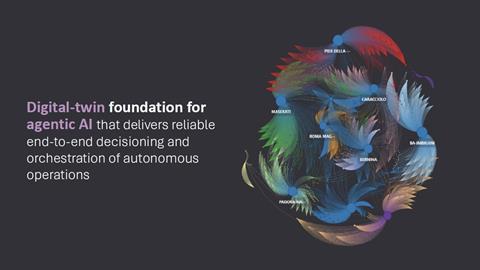
Carla Penedo, Executive Director of Cognitive Automation at Celfocus, showed a visualisation of the underlying graph, with sites and connections rendered as sweeping, coloured arcs, noting that it “looks like a painting” and, at another point in the presentation, also comparing it to a city map.

“ Think of the network as a city map: sites are the neighbourhoods; links are the roads; telemetry is the traffic cameras; and the digital twin acts like the traffic control room — predicting jams and redirecting the flows. ”
Use-cases: change impact assessment and root cause analysis
Change impact assessment was the first of the two use-cases described by Penedo to go live, delivering clear operational impact for Fastweb + Vodafone.
Engineers used to manually trawl multiple CMDBs, network management tools, and inventory tickets to determine which customers a planned change would impact. They can now query the digital twin and in under one minute get a breakdown of customers affected by segment (consumer, executive, or wholesale) across transmission and access layers. This used to take 30 minutes.
The second use-case was root cause analysis (RCA), aimed at accelerating the identification of problems at the source. When a fault hits, operations teams are flooded with alarms simultaneously across multiple domains.
She pointed out that IP engineers, for example, often cannot ascertain whether the true cause lies in their own layer, or in the underlying transmission layer.
Celfocus’s platform employs agentic reasoning to automatically trace the fault, with a human in the loop to validate the result before anything is closed out.
Through this project, Fastweb + Vodafone is targeting an 85% cut in alarm noise, 40% reduction in MTTR for remote fixes, and 20% fewer manual alarm checks.
Penedo explained that “the idea is to create a solution that can automate this type of correlation, combining the real-time alarms with agentic reasoning while keeping human validation, to guarantee that we can further reiterate and confirm the results.
“ These changes — these moves — turn a chaotic situation into a very controlled one because here we can reduce alarm noise. We can have lower minimum time to detect and resolve, with explainable RCA to guide the next steps.”
Penedo.
Three key takeaways for operators
Volonterio shared lessons for peers attempting similar transformation:
- Use-case-driven approach behind the investment: rather than treating the digital twin as an enabler built for its own sake, the programme deployed it alongside live use-cases from the outset. This way, every stage of the multi-year transformation can deliver a financial return, rather than deferring payoff to the end.
- The need for open, modular architecture: with a five-to-six-year build ahead, and Fastweb + Vodafone still running on two merged legacy estates, waiting for full physical network consolidation before adding new capability was never realistic.
- A partner with genuine network expertise rather than purely technical or generic IT capability: this wasn’t, in Volonterio’s view, a pure technology implementation, but one that required a partner who understood what a network is and the operational processes it serves.
“ If I’m waiting for the physical consolidation, I will wait [until] 2030 without delivering anything… We need to decompose the monolithic solution into pieces, ensure the open interface, and then have the possibility to compose. ”
Volonterio.
Volonterio also stressed the scale of internal validation required. With data pulled from dozens of legacy systems, this must be checked by the operator’s own engineers and operations teams. Without this, he said, nobody will sufficiently trust the results to act upon them.
Topics
- AI/GenAI/ML (artificial intelligence, agentic, machine learning)
- Automation
- Autonomous networks (zero-touch)
- AWS (Amazon Web Services)
- BSS/OSS
- Carla Penedo
- Celfocus (Novabase)
- Data
- Digital twin
- DTW Ignite (TM Forum)
- Events
- Eventwatch
- Fastweb + Vodafone
- Italy
- Mario Volonterio
- Network
- Network & Infrastructure
- Network Operations Centre (NOC)
- Operators
- Portugal
- Swisscom
- Switzerland
- System integration (SI)
- Technology
- Thought Leadership
- TM Forum (TMF)
- Vodafone Group
- Vodafone Italy