
























- Telco leaders around the world are braced for a wave of competitive disruption, amid a persistently challenging regulatory environment, according to the findings of EY’s latest Telco of Tomorrow research.
- Dr. Sören Grabowski, EY-Parthenon Partner, TMT at Ernst & Young LLP and Adrian Baschnonga, EY’s Global Lead Analyst tell TelcoTitans that, while heightened efficiency and a focus on the core business are the two main responses anticipated in the C-suite, a focus on differentiation could open opportunities for profitable new services and help overcome barriers to growth.
- The B2B sector is seen as coming of age, with differentiation also seen at the heart of a telco enterprise resurgence, and operator adoption of AI enabling innovation.
- Agentic solutions are trending up, with telcos needing to see themselves as “customer zero” to build credibility as an external AI provider by demonstrating internal adoption.
- While the geopolitical environment is placing a strain on economies and industries, forward-thinking telcos are eyeing the opportunity to stand out as trusted local technology enablers in an environment where sovereignty is critical.
The recent Telco of Tomorrow 2026 research study of C-suite executives from strategy consultancy EY-Parthenon paints the picture of a global industry wrestling with existential questions about how the sector should look.
CxOs brace for wider disruption
New challenges and opportunities are developing as AI-driven technology disruption reverberates across markets, and the best way forward is up for debate.
CxOs expect hyperscalers and satcos to become a greater challenge for traditional telcos over the next five years, with 60% of telco CxO respondents anticipating that webscalers will be a challenge in five years (up from 45% today). While satcos are not seen as an immediate threat (cited by just 18%, currently), this is anticipated by 66% of respondents within five years. Very recent developments might shorten this timeline significantly, however, and open the fight for supremacy between traditional telcos and satellite providers.
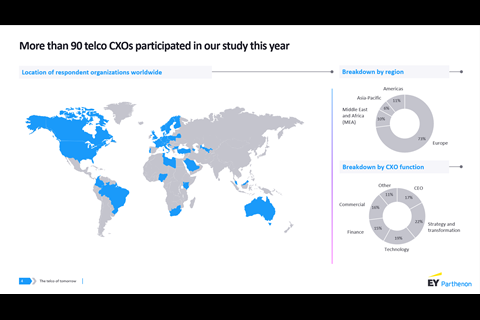
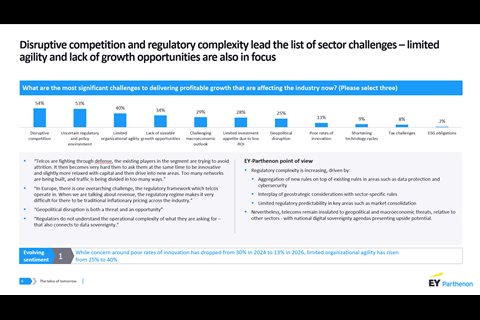
The study, based on interviews with more than 90 C-suite executives at operators in the Americas, Asia-Pacific, Middle East and Africa, but predominantly Europe, identifies disruptive competition as the leading current challenge for the sector, highlighted by 54% of CxOs.
This is closely followed by the challenges of working in a world of regulatory and policy uncertainty (cited by 53%), with a lack of agility within telcos wrapping up the top three constraints to profitable growth.
Despite these concerns, expectations for market growth remain largely positive, if modest, anticipating low-single-digit improvements in revenue and EBITDA over the next three years.
Although there are indications that both core and non-core services can help deliver this uplift, the two principal imperatives are familiar and rooted in the traditional. Greater efficiency and agility within the operating model headed the poll (81%), followed by maximising growth in the core business through better execution (79%).
Speaking to TelcoTitans, the report’s co-author (and EY-Parthenon’s Partner at Ernst & Young LLP in TMT) Sören Grabowski homed in on differentiation, the third key strategic approach to the market, suggesting this could provide a powerful antidote to the challenges faced by operators and promote growth opportunities in both core and non-core business.
Telco of Tomorrow 2026 is the second edition of EY-Parthenon’s global telecommunications leadership study, co-authored by Grabowski and EY’s Global Lead Analyst Adrian Baschnonga. It draws on one-hour interviews with more than 90 executives from integrated incumbents, fibre operators, MNOs and MVNOs, conducted between September 2025 and February 2026. Europe accounted for 73% of respondents, with participants spanning strategy and transformation, technology, CEO, commercial, and finance functions.
The challenge of meaningful disruption
Despite the telecoms industry’s recognition that differentiation is a strategic imperative, the study highlights a certain lack of confidence in operators’ own ability.
“There was this confidence that ‘actually, there’s more out there for us as a telco’”, observes Grabowski. “We thought it was interesting that the differentiation point was addressed with less confidence than we might have expected”.
More than a third (37%) of CxOs questioned whether telcos will be able to differentiate themselves from each other within five years, while 70% still view network quality as likely to be the most important aspect of differentiation in 2031 (up from 57% in EY-Parthenon’s 2024 survey). This is despite both superior customer understanding and software-centric skills being identified as competencies that are more likely to create differentiation than networks.
Grabowski is urging operators to lean into these emerging capabilities.
“To really differentiate, you need to just get closer to your customer”, he says. “Right now, you can really stand out from the crowd by doubling down on that and moving beyond reliance on the network, speed, and reach”.
There are clear ways for operators to set themselves apart on customer experience, with Grabowski highlighting the customer journey as an area where AI can be transformative.

“ Some of our own work with telco customers on differentiated customer experience is really focused on the role that AI can play in the sales experience, and having more or better AI-enabled sales functions developing an improved, closer, and more productive buyer-seller dynamic. This is a good way of standing out from the crowd, and something that you can actually do in the near-term. ”
He also asserts that there is value in a “customer-zero mindset”, with operators embracing AI internally as well as externally.
This potential to embrace AI, however, brings into the conversation another finding of the study, with European executives in particular holding a pronounced belief that software-centric skills will be an important lever as a differentiator.
The challenge, though, is in acquiring these capabilities, and running an organisation that can effectively engage them.
Turning customer insight into differentiation
With superior customer understanding emerging as the capability most likely to create differentiation, EY showcases its Studio+ solution, designed to help organisations turn customer insight into differentiated experiences and propositions. This combines human-centred design, technology, and commercial insight across customer experience, sales, service and product innovation.
The virtuous cycle of operational agility and software ability
Concern also appears to be shifting away from generating ideas to executing on them, highlights Baschnonga, with a lack of organisational agility evidently a growing concern in the sector, cited by 40% of CxOs in the 2026 Telco of Tomorrow research, compared to 25% in 2024.
This uptick, Baschnonga notes, accompanies the barrage of opportunities that have come with the AI development super-cycle. Operators are cognisant of the opportunities, but remain uncertain of their ability to move fast enough to seize them. This is despite considerable progress perceived in closing the gap to technology companies in terms of being digitally-native over the past decade. Worry about poor innovation has fallen from 30% to 13% over the same period.
Budget is also called out as a constraint, with Baschnonga unsurprised to see this traditional limiter of ambition listed at the top of barriers to progress identified in the study, pinpointed by 54%, along with a skills deficit (43%).
Senior figures are concerned that operators may not be able to attract the best talent, with only 31% envisaging the sector as one of the most attractive to work in within five years. This correlates to the concerns expressed about telco budgetary constraints, should skills deficiencies only be exacerbated when competing for talent with high-spending hyperscalers.
To counter this, Baschnonga advocates a holistic view of telco employees and skills, giving consideration to how processes can be reengineered and how teams work together. While a lack of internal collaboration was identified as a barrier to progress, he believes adoption of AI may help “redraw some of those internal relationships in a positive way”.
This feeds into a topic that Baschnonga sees as increasingly relevant: the rise of the agentic telco.
“What’s the breadth and scope of that agentic AI opportunity, and how quickly can operators move? While there is plenty of energy in terms of transitioning to agents in customer experience and network optimisation, the broader organisational blueprint for AI-native operations is still only forming. Looking ahead, a holistic approach is essential ”, he underlines.
B2B emerges as the next growth frontier
The differentiation opportunity for telcos may be underestimated, if telcos fail to see the wood for the trees.
While interest in non-core growth is increasing, cited by 50% of respondents against 34% in 2024, confidence in wholesale, platform, and as-a-service growth has fallen from 31% to 21%.
The enterprise sector may be particularly receptive and provide a clearer picture of the value of distinct services. “It’s been talked about for quite a long time, but B2B is finally having its day”, says Baschnonga.
The EY-Parthenon study indicates that operators are seeing multiple emerging areas to expand their service portfolio, for example around cloud sovereignty and cybersecurity, and AI- or GPU-as-a-Service, while autonomous networks open up the re-positioning of network strength around resilience as well as quality. “There’s a lot of scope there”, says Baschnonga, “and there’s more room to do more”.

“ If you look at the last 18 months, operators are warming to sovereign cloud and AI infrastructure opportunities, while there is an increased focus on cybersecurity, even prioritising the defence sector in Europe as a vertical. These signals point to an increasingly vibrant landscape of B2B opportunities for telcos and one where fine-tuning your ‘right to play’ is becoming more important. ”
In creating differentiation, Baschnonga says that “multi-sided partnerships are going to be important going forward”. Operators will need to work on distinguishing areas where they have a right and opportunity to deliver services, but equally identify where co-creating and co-delivering services will be the best approach.
This can already be seen emerging in the enterprise space, according to the EY sector analyst, “Where we heard more confidence from people in terms of that B2B growth trajectory is where their ecosystem strategy is front and centre in their thinking”.
Baschnonga is already looking ahead to the next edition of the EY-Parthenon study, and anticipating increased richness and sophistication in this ecosystem.
“ A lot of telcos are thinking through where they sit in the value chain. What does co-opetition look like? What does their ecosystem strategy look like? I’d expect that to rise up as a topic when we run this study again in the next 18 months. ”
Baschnonga.
The sovereignty opportunity to unlock telco worth
Baschnonga highlights that for the telecoms sector, geopolitical disruption around the world may be creating opportunity as much as risk.
Around a quarter of the C-suite respondents to Telco of Tomorrow identified geopolitics as a problem, and he remarks that “I think if we’d run this survey in other industries, we would have seen it higher”.
“ In a world where governments are looking to reduce their reliance on overseas vendors, the telco can become quite an attractive techco from a network and AI infrastructure perspective. So we thought that was quite interesting. ”
Grabowski.
This sovereignty-linked opportunity resonates particularly in the B2B sector, underpinning the confidence in the growth opportunity for many. For European operators, perhaps the only associated counterweight is concern expressed regarding the regulatory environment and predictability, but the analyst considers that optimism could win out.
“ The specifics around the telco as a national strategic asset, there’s upside there. And that came out strongly. It’s not something that stood out when we talked previously about policies, etc. This is kind of a new way of thinking about it, and we’re impressed with what we heard from people picking out the upside as well as the risks. ”
Baschnonga
Sovereignty may present another opportunity for operators to not only demonstrate, but also extract, the value they provide in enabling other industries and sectors to thrive and develop.
“ We heard a lot previously that telco is the catalyst for the transformation of other industries, particularly when 5G was launched. It feels like the sovereignty piece may be a continuation of that thesis putting telcos at the heart of the economy. ”
Baschnonga.
Explore the research: click through to read EY-Parthenon’s full Telco of Tomorrow 2026 study for further findings on CxOs’ growth expectations, strategic priorities, and five-year industry outlook.
Disclaimer: the views reflected in this article are the views of the author and do not necessarily reflect the views of the global EY organisation or its member firms.
Topics
- 5G
- Adrian Baschnonga
- Africa
- AI/GenAI/ML (artificial intelligence, agentic, machine learning)
- Asia-Pacific (APAC)
- Autonomous networks (zero-touch)
- Business/commercial model
- Cédric Foray
- Cloud
- Customer/User experience (CX/UX)
- Cybersecurity
- Data sovereignty
- Defence
- EMEA
- Enterprise (B2B)
- Europe
- EY
- Finance & Strategy
- Hyperscalers vertical (webscale)
- Infrastructure
- Interview
- Middle East
- Network
- Operators
- Opex (operating expenditure)
- Satellite
- Sören Grabowski
- Sovereign
- Sovereign Cloud
- Strategy & Change
- Tech & IT
- Technology
- Thought Leadership
- United States (USA)