
















- The satellite sector’s rapid evolution has seen the $1.2tn global telecoms sector become viewed as fair game, meaning operators must engage with new challengers to protect and grow their revenues.
- Celfocus-hosted summit hears how cultural, regulatory, and technical hurdles must all be overcome for successful integration and delivery of seamless D2D services.
- The industry must adopt a commercial outlook and resist becoming overly engineering‑driven to ensure services are not outpaced by shifts in customer demand and expectations.
- Closing that gap depends on a scalable and software-driven integration, with standards such as TMF Space ODA emerging as the connective layer making a compelling commercial proposition possible.
A new arms race of space-age connectivity — driven most notably by SpaceX and its disruptive Starlink internet service — represents both an enormous strategic opportunity and an existential threat for the established European telecommunications industry.
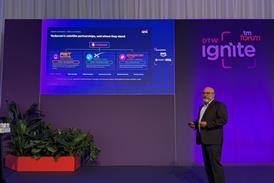
Philip Laidler, Consulting Director at STL Partners, stressed the scale of the battlefield during an introductory presentation at an executive summit, From Towers to Space: Monetising Global Coverage, hosted by European systems integrator Celfocus at DTW Ignite 2026.
He noted that the Connectivity segment of SpaceX’s S-1 IPO Prospectus filing “suggested an addressable market of $1.6tn [€1.4tn]”. This ambitious figure likely includes a substantial share of the global telecoms market, in total valued at $1.2 trillion, underscoring what operators might have to lose as well as what they might gain.
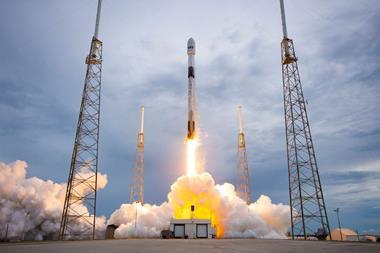
SpaceX’s ambition and rapid progress are demonstrated by the performance of its Starlink business division, which is on course to generate $12bn in revenue in 2026, with close to 10,000 satellites already in orbit.
Hybrid convergence gains momentum
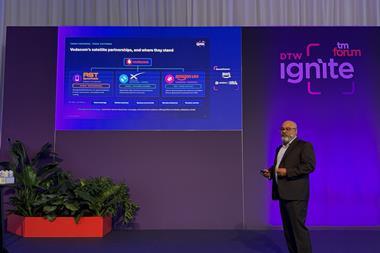
David Villegas, Founder and Principal Architect at satellite-terrestrial interoperability specialist firm Gauví, and previously Director of Digital Architecture at regional satellite major SES, described how the telecoms industry is charting a course towards a hybrid model in which non-terrestrial and terrestrial networks integrate seamlessly.
He outlined how this convergence is gaining momentum, with 91 telcos worldwide said to have already signed 275 deals with satellite operators in 101 countries.

Villegas, who works with the TM Forum on its satellite architecture standards, explained how satco and telco partnerships focus on maximising connectivity against the backdrop of regulatory and spectrum-related realities across multiple international markets.
He emphasised that integration represents a major commercial opportunity for operators to expand their addressable market, rather than a threat of total replacement.
This perspective is supported by a Strand Consult report published earlier this year, which concluded that low-Earth orbit (LEO) systems will expand options for consumers and enterprise customers, but will complement rather than replace traditional terrestrial mobile networks.
The focus, Villegas said, was on delivering a hybrid experience for consumers seeking “anywhere connectivity,” including remote-location, aviation, and maritime scenarios, and for government authorities seeking “backup and continuity for critical services” for disaster response and emergency use cases.
“Here we’re talking about hybrid connectivity. So, it’s not only direct-to-device, but it’s hybrid connectivity. What we are seeing now is that telcos and satellite operators are merging and creating combined products.”
Villegas.
Turning this hybrid vision into a scalable, sellable commercial proposition is where the hard work begins, however, as recent examples of D2D commercialisation show.
Commercial D2D services are expanding into more markets, but usage still depends on device compatibility, operator strategy, pricing, and local factors including spectrum access and licensing.
According to a report from Ookla published earlier this year, D2D adoption remains niche, with fewer than 1% of mobile users in most markets using satellite‑to‑phone services. Global D2D rose by 24.5% between July 2025 and March 2026, however. In the UK, for example, Virgin Media O2 (VMO2) now offers Starlink Mobile for free on its “Ultimate” plan, while charging customers £3 per month on other eligible plans.
This example of commercial experimentation coincides with the launch of Satellite Connect Europe, a Luxembourg-based joint venture between Vodafone Group and AST SpaceMobile previously known as SatCo. Led by Managing Director Meredith Sharples, the JV aims to provide D2D 4G/5G mobile broadband via AST SpaceMobile’s LEO constellation with investments in ground stations in France, Germany, Greece, Spain, and the UK.
The route to successful commercialisation remains challenging, however. AST SpaceMobile recently confirmed plans to raise $1bn (€880m) through a private debt offering to fund its intensive satellite launch programme. Alongside this financial move, the satco disclosed another delay to the launch of its commercial D2D services, now pushed to 2027 from late-2026.
Underneath these commercial setbacks lies a deeper, structural friction relating to how satellite operators and MNOs integrate their networks and back-office systems in the first place.
Unravelling the complexity
The path to integrating satellite and MNOs is fraught with complexity, as two different industries often operate in their own swim lanes amid tension in many markets. Starlink has grown a global footprint without acquiring spectrum rights or, in some cases, complying with regulatory obligations.
Joao Antunes, Head of Autonomous Networks at Celfocus, highlighted how integrating non-terrestrial networks adds another layer of extreme complexity for operators already navigating the challenges of multi-territory operations. As he explained: “If we think about terrestrial networks, they are already complex across multiple domains where you need to guarantee SLAs between all of those domains, make sure that the service runs across all of it. And then we go and add another layer of complexity”.
Connecting these two complex worlds creates significant technical and cultural friction. Oleg Grytsynevych, Senior Solutions Architect for Aerospace and Satellite Solutions at AWS, noted that “everything from the satellite to the ground segment is basically bespoke solutions”, lacking the unified standards of terrestrial 5G.
The real challenge lies in bridging these distinct operational mindsets, as satellite operators are forced to integrate seamlessly into MNO environments for the first time. As Grytsynevych emphasised, overcoming this gap will require modern software architectures: “Satellite operators will need to integrate with MNOs. And this is something which will be new for them… I would see cloud as an enabler of this integration”.
Villegas explained that integrating satellite into cellular networks requires a fundamental shift in how satcos operate. Moving away from traditional, static capacity sales, satellite operators must now support dynamic commercial services that require telco-grade billing, automated ordering, and robust service assurance.
While telcos have perfected customer journey workflows, satcos are still modernising their back-office processes to meet these demands. “These two industries, now that they are coming together, are where we see the friction,” Villegas pointed out. “They have the same concerns, but from a different angle”.
The standardisation imperative: SODA
To bridge this gap and monetise new services quickly, the players are looking to standards bodies including 3GPP, GSMA, and TM Forum to help fast-track collaboration and commercial use cases.
While 3GPP and GSMA are responsible for defining roaming standards and technical handoffs between mobile and satellite networks, the TM Forum’s Open Digital Architecture for Satellite (SODA) initiative also plays an important role in harmonising a fragmented European regulatory landscape.
In more concrete terms, SODA defines common APIs and data models for order management, billing, and service assurance, and directly addresses the bespoke, siloed integrations and static-to-dynamic billing challenges described above, so satcos and MNOs are not left building a one-off solution for every new partnership.
“Both mobile network operators and satellite network operators need to use the same language in order to interoperate”, said Vipul Manglik, Head of Architecture at Eutelsat Group.
Cloud technology will be a critical enabler here, with Grytsynevych noting that shifting to software-defined architectures “can be accelerated with standards which are emerging now”.
Sovereign priorities and the spectrum backdrop
Alongside this integration and commercialisation agenda, the session also touched on the policy backdrop shaping Europe’s satellite strategy.
The session highlighted how operator priorities are split between seeking new commercial growth markets and securing sovereign, critical infrastructure back-ups.
Eutelsat’s Manglik noted that demand for sovereign services gives European operators a key edge when competing against US giants such as SpaceX and Amazon LEO, formerly Project Kuiper: “The sovereign backup helps [European operators] to go into the market and capture that space”.
The European Union (EU) has meanwhile entered the deployment phase of its IRIS² satellite programme. Under a new implementation agreement with satellite operators Eutelsat, Hispasat, and SES, the IRIS² constellation will now comprise 348 satellites to support “defence, security, and emergency services”, with the first satellites scheduled for deployment in 2029.
A related decision could prove just as consequential for Europe’s D2D market structure. The EU is preparing to re-release the 2×30 MHz MSS spectrum band at 2 GHz as original 2009 rights expire in 2027. The upcoming allocation is pivotal: to avoid fragmentation and build regional scale, the EU plans to divide the band by reserving one-third for government use, one-third exclusively for European carriers, and opening the remainder to external satellite players.
This controlled allocation model contrasts with the US’s domestic-only approach and aims to ensure European operators secure the footprint needed to build a trusted, coordinated continental system rather than a piecemeal national framework.
A ‘Nokia moment’?
Delivering this kind of simplicity, participants argued, is what ultimately separates operators that scale hybrid connectivity from those left behind.
During the session, an audience member warned that the industry might be facing an inflexion point like the one experienced by the smartphone sector nearly two decades ago, when the iPhone precipitated the decline of Nokia’s handset business by focusing on customer experience rather than just the underlying technology and engineering.
“I like the ‘Nokia’ metaphor there”, said Celfocus’s Antunes, building on this theme and stressing the need to “take away the friction” for both consumers and enterprise customers alike. For satellite integration to scale into a mainstream, cloud-native telco service, it must move past being perceived as “rocket science”, with success belonging to the operators that can make ubiquitous connectivity completely simple.
Manglik echoed this, stating that the entire ecosystem must shift from an “engineering-driven mindset to a self-serve mindset” because end-users don’t care about what’s happening in the background.
For telcos, the challenge is to lead this integration before they find themselves on the wrong side of the next “Nokia moment”.
As Laidler said during his presentation, there is “a lot of interest, a lot of speculation, a lot of investment and a great deal of disruption and change… Now someone has to deliver against that disruption. Where the rubber hits the road, we have to put in place those ecosystems in a way that they [the operators] can deliver against that”.
Topics
- 5G
- AST SpaceMobile
- AWS (Amazon Web Services)
- Business/commercial model
- Celfocus (Novabase)
- Cloud
- Convergence
- Customer/User experience (CX/UX)
- David Villegas
- Defence
- DTW Ignite (TM Forum)
- Emergency Services Network (ESN)
- Emergency Services vertical
- Europe
- European Union (EU, EC, EP)
- Eutelsat
- Events
- GSMA (GSM Association)
- Infrawatch
- Joao Antunes
- Legal (compliance, regulatory)
- Network & Infrastructure
- Oleg Grytsynevych
- Open Digital Architecture (ODA)
- Operators
- Partnerships & Alliances
- Philip Laidler
- Roaming
- Satellite
- Satellite Connect Europe
- SpaceX
- Spectrum
- Standards
- Starlink
- STL Partners
- Strand Consult
- Technology
- Thought Leadership
- TM Forum (TMF)
- United States (USA)
- Vipul Manglik
- Virgin Media O2 (VM O2)