


























- Market consolidation is among the key factors driving an urgent need for automation, with network efficiency a key determinant of telco valuation.
- FNT Software and Inmanta white paper underlines value of telcos acting decisively on network automation projects to keep pace with sector digitalisation.
- An incremental, ‘Start Small, Scale Fast’ approach is advocated for quick wins and process validation, fuelling further progress.
- Unified network inventory underpins end‑to‑end automation, working in tandem with intent‑based orchestration to create a virtuous cycle of data enhancement, powering a “flywheel of compounding value”
- The four-stage framework aligns with TM Forum standards, guiding operators from defining scope to full ‘design and assign’ automation loops.
- Real-world implementations highlight opex gains and reduced technical debt, with international wholesaler BICS reporting efficiencies of up to 70% through consolidated inventory, and the UK’s Freedom Fibre has leveraging automation to slash tech debt, accelerate time-to-market, and reduce opex.
The need for effective tools to automate and manage the complexities of modern networks is an increasingly urgent priority across telecom markets.
Efficiency, agility and customer experience aside, this is also materially influenced and evidenced by the rapid pace of market consolidation and related due diligence. Make-or-break valuations are being placed on value and compatibility at a time when networks are increasingly multi‑vendor, multi‑domain, and even multi‑technology environments.
Network providers are not in a position to ignore automation projects until restructuring of the market has shaken out. As scrutiny builds on their prospects, whether as buyer or seller, judgements of value and viability will include efficiency, innovation and responsiveness to market conditions.
Quite simply, inefficient network infrastructure can undermine overall business valuations. Even for businesses not actively anticipating consolidation, such inefficiency should ring alarm bells that the network is not running on all cylinders.
In their new joint white paper, Start Small, Scale Fast, network management and orchestration partners FNT Software and Inmanta outline how acting now and taking an incremental approach to automation projects can accelerate arrival of anticipated benefits, with immediate gains validating the process and fuelling further transformation.
There is risk that operators take an overly cautious approach and wait for completion of interrelated processes such as inventory upgrades before progressing with change. But these upgrade projects can take three to four years, with the danger that change comes too late and more agile competitors move ahead.
The time for action is now, assert FNT and Inmanta, starting with creating a clearer picture of the current network environment.
Inmanta is an end‑to‑end network and service orchestrator for the telecoms sector, while digital infrastructure management solutions provider FNT Software has developed a versatile inventory platform to manage the complexity of network environments. Collectively, they deliver the two key pillars for effective automation, and create a virtuous cycle of effective inventory and orchestration that enables operators to secure operational, customer, and strategic gains.
Overcoming the growing pains of a rapidly digitalising environment
Communications service providers are constantly under pressure to move faster, meet tougher service level expectations, and optimise costs in increasingly complex multi‑vendor network environments.

Attempts to pursue these goals are often derailed by an incomplete picture of network data that makes it difficult to automate workflows, according to the white paper. In this environment, silos of duplicated and outdated information obscure understanding of resource availability and service impact from changes, perpetuating fear of unintended consequences exacerbated by lack of insight into how different systems are interrelated.
FNT and Inmanta see this challenge being addressed through a foundation built on ensuring network visibility and orchestration work together in a unified automated loop, with clear inventory enabling intelligent orchestration, which in turn ensures that data within the loop is kept current.
“ Inmanta’s highly programmable intent-driven service orchestration suite is complemented with FNT Software’s state-of-the-art network inventory solution, which natively supports any traditional or cloud network. From the digital service provider’s perspective, such a combination facilitates seamless service fulfilment as well as rapid onboarding of new network technologies. New service delivery models are implemented faster, having positive impact on time-to-market for new products.”
Daria Batrakova, Director Business Line Telecom Solutions, FNT Software.
Creating a ‘living model’ for inventory to accelerate transformation
Building on foundations of data accuracy, the partners highlight how development of a unified inventory can deliver a “single source of truth” for all network assets, taking into account configurations, locations, and interdependencies, and bringing multiple systems.
This can support what the white paper describes as a “living model” of the network that reflects both current reality and the planning state of the infrastructure as upgrades and improvements are readied. Through this, service providers can assess the impact of change ahead of implementation, and, once new services are put live, changes can be synchronised across systems to ensure the network picture remains accurate and consistent.
Clarity and confidence are critical as service providers pursue an incremental approach to automation, enabling additional network domains to be brought into the process without requiring new inventories. FNT points to its online catalogue, which provides fully modelled device templates for more than 80,000 network components. These feature critical vendor technical data, enabling a fast start and incremental onboarding of more inventory as automation progresses.
The process advocated by FNT and Inmanta is aligned with industry standards and frameworks, such as the TM Forum’s Open Digital Architecture. This reinforces interoperability, consistency and scalability, including integration of new technologies and vendor solutions.
FNT highlights that its solutions have been deployed with multiple fibre operators in Europe, with its centralised and integrated network and services inventory management system FNT Command delivering as that essential “single source of truth”. Benefits include seamless integration of address information that lays the groundwork for FTTH delivery, helping streamline network correlation, installation, and onboarding. The system is supporting FTTH for customers in multiple geographies, including country-wide networks, with what FNT describes as “unprecedented efficiency and reliability”.

Orchestrating with intent to reach goals beyond provisioning
Working in tandem with unified inventory, FNT and Inmanta flag that orchestration can become truly intent‑based, and effectively be driven by modelling.
Drawing on clear definitions of service providers’ goals in the context of an enhanced data structure, the orchestrator can itself determine how to deliver objectives. Significantly, this can automate the transition from intent to configuration across physical, virtual and cloud environments, minimising manual engineering and improving consistency.
Inmanta highlights that true orchestration “goes beyond provisioning”. Working in coordination with a unified inventory, this can manage the full service lifecycle, from design to decommissioning, including in-between lifecycle states (such as activation and modification).
The constant exchange between inventory and orchestration also enables predictive maintenance, quicker recovery, and the introduction of self‑healing across networks.
Inmanta points out that the UK’s Freedom Fibre has deployed an automation solution based on this approach to support the end‑to‑end lifecycle of fibre service delivery across its open access network. By implementing Inmanta’s orchestration, the acquisitive Manchester-based altnet aims to scale its operations efficiently, targeting improvements in time‑to‑service and greater consistency, while also minimising operational overheads and technical debt.
“ Going live with our automation solution is a key step in scaling our network and improving customer experience.”
Lindsey Sutherland, Chief Operating Officer, Freedom Fibre.
Stepping up automation with an incremental path
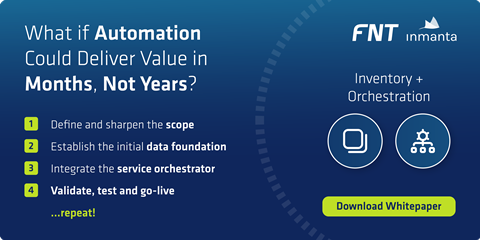
The gradual approach to modernising network inventory and service orchestration recommended by FNT and Inmanta breaks down into a four stage self‑reinforcing process:
- Define and sharpen focus. Initiating the incremental process begins with bringing network inventory and service orchestration teams together to define the initial scope of the engagement, focused on targeted use cases where automation can best deliver tangible results and demonstrate value.
- Establish data foundations. Relevant network domains are reconciled into a unified inventory, creating an accurate snapshot of all assets, whether physical, logical or virtual. This aims to provide a reliable foundation that can be built upon and refined through orchestration.
- Deploy and integrate a service orchestrator. This orchestrator is intended to “design and assign” network and services resources directly in the inventory, creating a feedback loop to enhance accuracy that reinforces data reliability and elevates automation maturity.
- Validate, test, and go live. Incremental changes are verified and trialled in the field. Once stability and performance are validated, the system can move into live operation delivering business value and opening the opportunity for further automation use cases.
Major benefits build as automation projects progress
The gains from adopting this incremental automation approach are considerable, according to the partners.
Inmanta notes work with global communication platform specialist BICS to demonstrate that consolidating inventory data and automating more routine network operations can reduce operating expenses by up to 70% in a manner that is replicable and accumulative.
The white paper also flags greater operator agility and improved time-to-market enabled by real‑time inventory visibility and cross‑domain orchestration. Available resources can be identified instantly and configured automatically, potentially bringing down the time taken to introduce or modify services from weeks to days.
Reliability is also said to be boosted, with trusted inventory information providing the baseline for “first time right” task delivery across service provisioning, modification, and activation. This should reduce rework, minimise service disruption and maintain consistency, in turn boosting customer trust.

FNT and Inmanta reference a “flywheel of compounding value” that comes through an incremental approach, with the benefits of early improvements feeding into further gains.
Ultimately, with its focus on trusted data, standardisation, and intent, the unified model is said to provide the fundamentals for future network transformation, such as closed loop automation, autonomous networks, and sustainable resource management.
“ Developing a unified network inventory, working in harmony with service orchestration, delivers asset and domain visibility that can be turned into immediate consistent action. By clearly identifying specific use cases, processes can quickly be automated step-by-step, and bring measurable gains.”
Stefan Walraven, CEO, Inmanta.
Topics
- Automation
- BICS
- BSS/OSS
- Daria Batrakova
- Digital transformation
- Europe
- Fibre (FTTC/FTTP)
- Fibre Challengers
- FNT Software
- Freedom Fibre (VX Fiber)
- Inmanta
- Lindsey Sutherland
- Mergers and Acquisitions (M&A)
- Network & Infrastructure
- Open Digital Architecture (ODA)
- Operations
- Opex (operating expenditure)
- Steven Walraven
- Strategy & Change
- Suppliers & SCM
- Thought Leadership
- TM Forum (TMF)
- United Kingdom (UK)