





















- Long-term commercial success in Africa’s fixed-broadband sector will depend on operational execution, productisation and wholesale enablement, rather than physical network rollout alone.
- Substantial capital commitments from development finance institutions and leading operator groups are driving regional connectivity, yet fixed-broadband penetration remains at an early stage with significant headroom for expansion.
- Open-access and wholesale models improve capital efficiency by decoupling physical infrastructure from retail service delivery, enabled via automated partner onboarding, billing, and settlement systems.
- Divergent market dynamics across South Africa, Kenya, North Africa, and Rwanda illustrate that fibre business models must be innovative and flexible to adapt to local purchasing habits, including prepaid voucher systems and digital payment integration.
- Operational transformations in international markets demonstrate the power of modern BSS architectures and open APIs for operators seeking to scale multi-partner wholesale ecosystems.
Africa’s fibre network build-out is becoming a test of commercial execution as much as network construction.
Operators, fibrecos, investors and governments are deploying capital to improve broadband access and support wider digital economy ambitions. Network reach is only the first step. The more challenging task is to turn capacity into services that households, businesses and service-provider partners can discover, afford, order and use.
Africa Finance Corporation (AFC) argues that physical infrastructure needs complementary cloud capability, digital platforms, enterprise software and services if access is to generate economic activity. Ghana offers one illustration, where AFC estimates that digitally delivered-service exports account for 6.3% of GDP, broadly comparable with India and the Philippines.
The relationship is already economically significant, with the GSMA estimating that mobile technologies and services alone contributed $240bn to Africa’s economy in 2025, while also identifying usage, rather than coverage, as the more pressing challenge in many countries.
Conversations with ZIRA Group, a European BSS specialist working with fibre and wholesale operators, helped prompt the question explored in this article: what must change beyond the network for fibre investment to generate sustained take-up and returns? Its contention is that the value of new fibre depends on how readily providers and partners can turn capacity into usable offers.
This article tests that proposition against Africa’s investment momentum, growth outlook and varied fibre business models, drawing on operator and infrastructure examples from the continent and beyond.
Assembling Africa’s digital system
The money behind Africa’s digital build-out increasingly appears to be following an ecosystem logic.
Fibre access networks sit within a wider system of regional backbones, metro networks, mobile backhaul, carrier-neutral data centres, cloud connectivity, subsea capacity and, in remote areas, satellite services.
Recent moves illustrate the convergence, with regional wholesaler WIOCC Group raising $300m from Africa Finance Corporation and Vision Invest for carrier-neutral data centres, open-access terrestrial fibre and subsea infrastructure, and MTN extending its portfolio across fibre, towers, backbone, data centres, cloud and fintech.
Operators and infrastructure funds sit alongside governments, development-finance institutions, strategic investors and global technology companies. A common requirement is not simply more assets or kilometres of fibre, but affordable access, operational resilience, partner participation, and credible routes to recurring revenue.
New subsea systems, including 2Africa, are increasing international capacity. The commercial task is to carry that capacity inland and translate it into affordable retail, enterprise and wholesale services.
Investment aligned with momentum
Investment in African connectivity is gathering pace, with capital flowing into access networks, backbone infrastructure and cloud connectivity as operators, infrastructure funds and development-finance institutions position for rising demand.
Operators across sub-Saharan Africa are projected to invest $62bn in connectivity infrastructure between 2023 and 2030, according to the Broadband Commission and ITU’s State of Broadband in Africa 2025.
Current disclosures from Airtel Africa, MTN, Orange and Vodacom imply a combined annual capex run-rate of roughly $6bn from the continent’s largest operator groups.
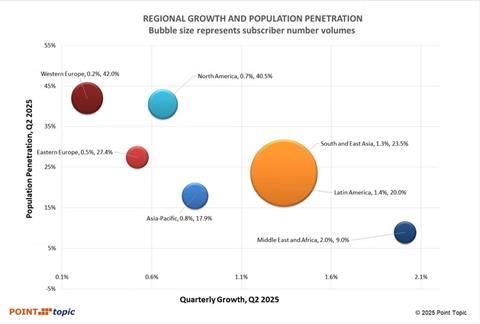
Within this major investment flow, fixed broadband remains at an early stage of development, leaving substantial room for expansion.
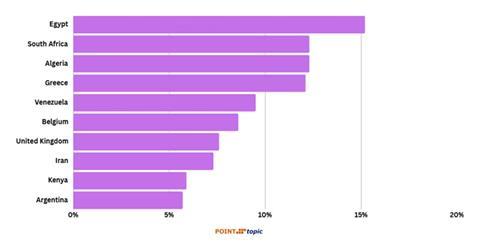
Broadband researcher Point Topic places Africa, and more recently the combined Middle East & Africa category, among the lowest-penetration but fastest-growing fixed-broadband regions. South Africa led its country growth ranking in Q2 2025, with nine further African markets in the top 20. The analyst forecasts 39.4% fixed-broadband subscription growth across Middle East & Africa between 2023 and 2030, the fastest increase of any region.
Algeria, Egypt and South Africa also feature among the continent’s stronger FTTH/B growth markets.
Business model: wholesale change
The case for fibre becomes stronger when infrastructure can serve more than one retail proposition.
Wholesale and open-access models can improve the use of capital-intensive networks, reduce duplication, and widen retail and enterprise choice. This allows a fibreco to focus on network build and operations, while ISPs, carriers and enterprise providers concentrate on distribution and customer relationships.
This division of labour changes the systems required. While a retail provider serves one customer base, an open-access fibreco must support several partners with reliable coverage, product and price data, ordering and fulfilment workflows, service assurance, billing and settlement.
ZIRA Group sees this as the point at which fibre becomes a business-design challenge. The aim is not necessarily to replace every legacy platform, but to introduce the capabilities needed to add services, partners and coverage areas without creating a new bottleneck.

“A fibre network is not automatically a wholesale business. The commercial foundations have to be built to support growth.”
What an open-access-ready fibreco needs
ZIRA Group’s own framework focuses on the practical requirements of serving several partners and routes to market.
In The Fiber Revolution: Beyond Infrastructure, ZIRA Group identifies four requirements: end-to-end fibre processes; wholesale-partner capability; open integration; and commercial scalability. In practice, that means a usable product catalogue, accurate availability and pricing, repeatable partner onboarding and order flows, and connections to workforce, network and finance systems.
The objective is flexibility as conventional subscriptions, enterprise services, prepaid access, and wholesale propositions may all be required as a market develops.
“The important question is not whether an operator can replace every system. It is whether it can introduce the capabilities needed to launch new services and partners without creating another legacy bottleneck.”
Amir Turalić, Chief Product Officer, ZIRA Group.
For more on this approach, see ZIRA Group’s The Fiber Revolution: Beyond Infrastructure.
Africa Eventwatch: The ZIRA Group team will be in attendance at ITW Africa in Nairobi on 7-10 September, and Africa Tech Festival (AfricaCom) in Cape Town on 17-19 November to outline how their modular platform can support rapid, flexible, and local commercialisation across Africa.
South Africa shows business models moving fast
South Africa provides a practical example of fibre providers adapting commercial models as well as expanding networks. About six million of the country’s 22 million residential and business premises have been passed by fibre, with take-up estimated at around 40%.
Vivica Group’s structurally separated fibreco, Frogfoot Networks, and ISP Vox Telecom (which includes the prepaid-fibre brand Hypa) recently secured ZAR14.4bn ($900m) in funding. Their reported plan is to increase annual homes passed from about 80,000 to 360,000, with a focus on underserved and lower-income townships.
The strategy also addresses a demand constraint. Monthly contracts may not suit every household’s budget or cashflow, making prepaid and voucher propositions one route to wider take-up. That in turn requires flexible product configuration, payments, distribution and customer support.
South Africa’s multi-ISP fibre market makes the challenge particularly visible. Frogfoot says it serves 120 ISP customers through wholesale FTTH and interconnect services, alongside larger networks including Vumatel/MAZIV (a joint venture with Vodacom), Openserve (Telkom) and MetroFibre. In that environment, coverage is only one differentiator; pricing, onboarding and service delivery also shape outcomes.
Prepaid fibre may not be Africa’s universal model but this example shows why product design, payment options and distribution must flex to accommodate localised demand and cashflow conditions
ZIRA Group makes the point that it is not that prepaid fibre will become Africa’s universal model, but that product design, payment options, distribution and margin management must reflect local demand and cashflow conditions. These are commercial-system questions as much as retail-marketing ones.

“African operators and fibrecos are often creating models for local conditions rather than copying established markets elsewhere. The systems underneath have to be flexible enough to support that innovation.”
Different markets, common operating principles
Africa’s fibre opportunity is substantial, but it is far from uniform.
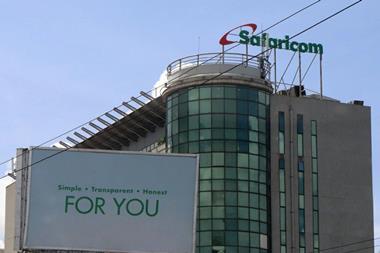
Kenya presents another sizeable, fast-scaling East African model. Fibre subscriptions passed 1.2 million by June 2025 in a market led by Vodacom-affiliated Safaricom, alongside Jamii Telecommunications and Wananchi Group. Mobile-led consumer behaviour, fixed wireless and digital payments make product design and customer experience as important as further coverage.
North Africa presents another pattern: Egypt and Algeria represent larger populations, established fixed incumbents and policy-led fibre strategies, while Morocco brings a more mature fixed-and-mobile market with regional operator reach.
Rwanda, meanwhile, illustrates a smaller public-private model in which terrestrial fibre and satellite can be complementary.
The commercial structures differ, but the principle does not: systems and partner models must fit local routes to market, not merely network plans.
Ireland offers a transferable lesson
Virgin Media Ireland offers a useful example of how network transformation can create a wholesale operating challenge.
As the Liberty Global-owned operator moved from coaxial cable towards FTTH and XGS-PON, it launched a wholesale-fibre business requiring new workflows, product and catalogue data, partner access, and B2B2X lead-to-cash capability. ZIRA Group says the programme integrated workforce management, fulfilment, GIS and incident systems, with self-service and TM Forum Open API access for partners. Technical use cases went live in around a year, followed by wholesale agreements with national retail providers.
“With Virgin Media Ireland, building a wholesale-fibre business required more than the network itself. It required a flexible commercial and BSS foundation that could evolve with the business and support a growing partner ecosystem.”
Amir Turalić, Chief Product Officer, ZIRA Group.
The point is not that an Irish model can be transplanted into Africa but that operators moving to multi-partner fibre models need systems that can support their chosen route to market.
The commercial layer matters
The next phase of African fibre growth will be judged by more than construction progress.
Local economics, payment patterns, regulation, geography and partner structures vary widely. Across those differences, however, fibrecos and operators need a practical way to turn network reach into services that customers and partners can buy and use.
“The ability to scale the commercial side of the business as quickly as the network will be central to turning infrastructure investment into sustainable growth.”
Emir Bukvić, Group CEO, ZIRA Group.
For fibre providers entering their next build phase, making capacity easy to package, buy, deliver and manage may prove as important as making it available.
Founded in 1996 by Zijah Rašidagić, ZIRA Group has evolved from a pioneering regional European software house into a specialised BSS and revenue-management vendor with operations and customers in more than 30 countries. Its software helps telecom and digital-service providers configure, launch and manage services, partners, orders, billing, and revenue flows as business models change. Differentiating itself from monolithic legacy vendors through open APIs and modular, domain-specific deployment, ZIRA Group works with international telecom operators including Mobily, Open Fiber, stc, TAWAL, Telecom Italia, and Virgin Media Ireland. Its strategy centres on helping wholesale fibrecos, towercos and CSPs manage complex B2B2X models to efficiently monetise next-generation digital networks.
Editor’s note: ZIRA Group is a contributor to this article, but the analysis also draws on market research, public-company disclosures, and examples from African operators and infrastructure providers.
Topics
- Africa
- Airtel Africa
- Amir Turalić
- API
- Billing (charging)
- BSS/OSS
- Business/commercial model
- Capex (capital investment)
- Cloud
- Emir Bukvić
- Europe
- Events
- Fibre (FTTC/FTTP)
- FibreCos
- Financial & Performance
- Fixed broadband (FTTx)
- France
- Ghana
- GSMA (GSM Association)
- India
- Infrastructure
- Ireland
- IT
- ITU (International Telecommunication Union)
- Kenya
- Liberty Global
- Maziv (Herotel/Vumatel)
- MTN Group
- Network & Infrastructure
- Nigeria
- Operators
- Orange
- Safaricom
- South Africa
- Technology
- Telkom SA (Telkom South Africa, MetroFibre, Openserve)
- Thought Leadership
- TM Forum (TMF)
- Venturing & Investments
- Virgin Media Ireland
- Virgin Media O2 (VM O2)
- Vodacom
- Wholesale
- ZIRA Group