




















- MWC26: DT, Mavenir, and Telefónica provide insights into autonomous networks and monetisation objectives underpinned by agentic AI.
- “Voice is sexy again” is a new mantra as operators seek revived relevance, with ambitions to bring much more to the table, including edge-as-a-service and customer-managed data consent.
- Panellists emphasise that transition from AI-integrated functions to natively embedded AI is essential if they are to achieve fully autonomous networks by 2030, and the financial and strategic uplift that will come with this.
- Despite rapid pace of innovation, telcos must prioritise rigorous security, governance, and the mitigation of AI hallucinations to ensure absolute network reliability.
Deutsche Telekom and Telefónica have agreed that “voice is sexy again”, as this most traditional of services is given new life by innovative, AI‑infused technology.

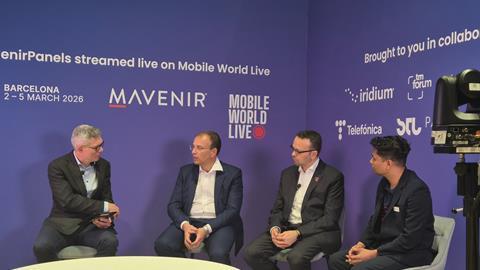
During a panel session hosted by Mavenir at Mobile World Congress, titled ‘AI-integrated to AI-native: Unlocking telco value in the agentic era’, Ahmed Hafez, Senior Vice-President for Network Strategy and Data & AI in Networks at DT, highlighted the telco’s unveiling, among other AI‑focused initiatives, of Magenta AI Call Assistant, a voice‑based AI agent developed in collaboration with UK tech startup (and DT investment) ElevenLabs.
The solution initially provides call summaries, live translation, and voice-based search engine tools, with DT planning to add more features. It follows recent beta launch by T‑Mobile US of a Live Translation service, underpinned by an agentic AI platform embedded in the operator’s 5G Advanced network.
Citing a comment made by Abdurazak Mudesir, Head of Technology & Innovation at DT, during the telco’s press conference at MWC, Hafez said AI is helping to bring voice “back from the ashes”. He described this as a “really a great opportunity” for operators as they seek new revenue‑generating use-cases. Mudesir also said that “the most natural user interface of choice for AI is voice”.
When announcing the Live Translation offering in February, T-Mobile Chief Executive Srini Gopalan described it as “enabling people to speak to each other, which [in] the end is the core purpose and mission of our industry”.
Agentic AI: not just about finding lost voice

Fellow panellist Cayetano Carbajo, Core, Transport, Innovation & Ecosystem Director at Telefónica, added that communication in general should be “sexy again”, and envisaged that agentic AI could help operators regain lost ground in other areas, too.
“We want to be relevant. We can provide new services to our customers”, Carbajo declared. At the same time, he warned that, when services are dependent on devices, “the whole definition of the service is much more difficult, and I think we need to eliminate this hurdle because innovation will increase a lot if we have cooperation with operating systems”.
Meanwhile, Bejoy Pankajakshan, Chief Technology & Strategy Officer at Mavenir, said that although voice‑related services are clearly top of mind right now, “we believe there is a bigger opportunity that operators are missing out on”.
Here, he cited potential offerings such as a consent‑as‑a‑service (a type of front-end AI data consent portal that operators would manage on behalf of customers) and edge-as-a-service.
“ These are new avenues which I don’t see a lot of operators talk about. It’s the easy services that you talk about, which is around the translation, but there is a bigger opportunity in the market if you have the right mindset. ”
Pankajakshan.
On consent, Carbajo noted that “we are working in standardisation bodies for defining the consent acquisition procedure and making this more user friendly, because we consider as an operator that this will be key”.
“ There will be a need of many elements for the agentic economy to work. Consent will be one of them, authentication and identification of [the] agent as well. ”
Carbajo.
DT’s Hafez added that while voice is shaping up to be an important opportunity, “it’s not ‘it’. The sky’s the limit. We can talk about a huge amount of possibilities”, ranging from fake voice detection through to enhanced security services, enabling customers to configure their own services, and the “hyper” customisation of solutions especially for enterprise users.
Agentic AI: discovery-mode
Carbajo and Hafez agreed that the move towards autonomous networks and monetisation through new or enhanced products and services are key telco priorities that will be aided by agentic AI.
Here, Carbajo reiterated Telefónica’s goal to achieve near-fully embedded autonomous systems by 2030, or ‘Level 4’ network autonomy, as defined by the TM Forum. “In fact, without agentic, it will be, in my opinion, impossible to reach this Level 4”, he said.
Hafez pointed to a third pillar that has yet to be realised, native or embedded AI, “Embedded AI for us is when you start building the network functions with AI components within”, he said.
Mavenir’s Pankajakshan added that there is still a lot of industry confusion about “what is AI-integrated, AI-embedded, AI-native”.
“ Today, you see a lot of talk out there on ‘AI‑RAN’ being ‘AI-native’.
So, there, the definition is, ‘you’re actually building networks which are natively done using AI’. The functions today that are embedded in standard code are being developed in a totally different way, and that direction we see as the future, versus the initial use cases, whether it be around autonomous network delivery using agentic agents or monetisation use cases [such as] AI translation. Those are all being delivered as an integrated function initially, but you could do the same thing in the future, more natively, when it’s being developed, ground up as an AI native solution. ”
Pankajakshan.
There was no dispute on the panel that this road to a fully agentic AI‑native ecosystem is littered with challenges. On network automation, for example, Telefónica’s Carbajo highlighted the inherent difficulty in accessing network data without putting that data at risk when training large language models.
“ For monetisation, I think the architecture for delivering the new services — not only complementing services, but brand new services — has to be defined. [In the meantime,] we need to start building interfaces that will allow this agentic interface with networking in an easier way, decoupling from the complexity of the network, and having the agent exposing these services. ”
Carbajo.
Moving fast to invent (or break) things
Hafez observed that agentic AI will not come “free of charge”, referring to the need for security, governance, and monitoring of the new systems.
“ The whole discussion about how you would manage that system going forward, which we have not been doing, is a complete transformation of our skillset: how we do things; how we look at different things; how we integrate; what kind of interfaces; how do we plug in data; how we clean data. ”
Hafez.
Hafez emphasised that DT “decided not to wait until everything is solved… so we went in and we started already developing multi-agentic AI”.
He pointed to the operator’s launch of the AI RAN Guardian Agent — a mobile network performance monitoring tool — in collaboration with Google Cloud in 2025.
During this year’s MWC, DT showcased the Multi-Agentic Intelligent Network Diagnostics and Remediation (MINDR) solution with Google Cloud and described the system as an “evolution” of AI RAN Guardian Agent.
Carbajo concurred that “everything regarding AI is happening very fast”, but also noted the risk of “decoupling the speed of the innovation in AI and the speed of innovation in network”.
“We have to increase our capacity for innovation, for catching up”, while also maintaining the high levels of network reliability when automating through AI, he said.
“ Reliability of [the] agentic era is not yet there. We have to be very careful. Hallucinations, for instance, when you are managing a network, will be catastrophic, and we have to put all the criteria that will allow us to manage the network in a safe way. Security and governance are key. ”
Carbajo.
Topics
- 5G
- Abdurazak Mudesir
- Ahmed Hafez
- AI/GenAI/ML (artificial intelligence, agentic, machine learning)
- Automation
- Autonomous networks (zero-touch)
- Cayetano Carbajo
- Deutsche Telekom Group (DTAG)
- Edge
- Edge computing (MEC)
- Events
- Google (Alphabet)
- Google Cloud
- Mavenir
- MWC (GSMA Mobile World Congress)
- North America
- Products & Services
- RAN (radio access network)
- Security
- Standalone 5G (5G SA)
- Strategy & Change
- Telefónica Group
- Thought Leadership
- TM Forum (TMF)
- T-Mobile US (DTAG)
- United States (USA)
- Voice