












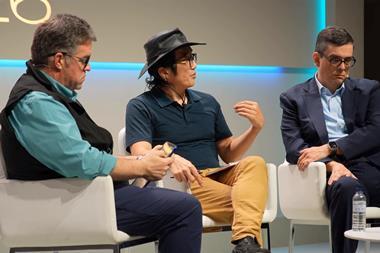
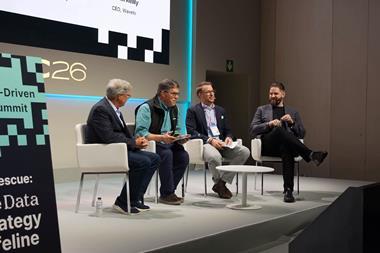
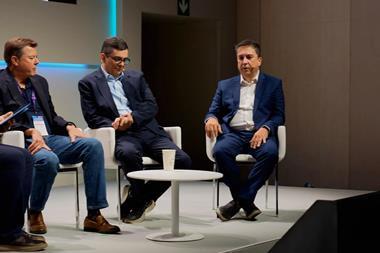
The Data-Driven Telco Summit 2026, Panel Discussion 2
— OSS/BSS Data Strategies for AI Success
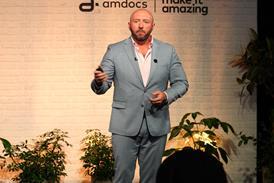
- Moderator: Matt Leary, TelcoTitans.
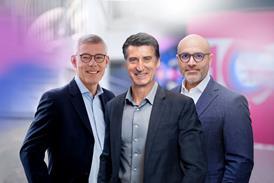
- Panelists: John Abraham (Appledore Research), Bob Dietrich (Wavelo), Koenraad Peeters (Ciminko).
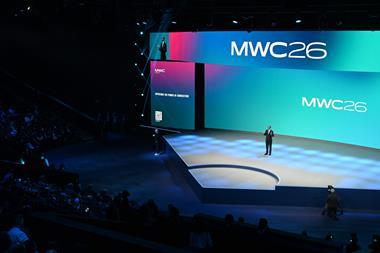
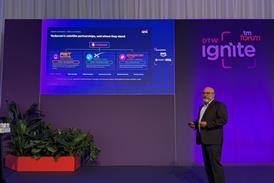
Session two of The Data-Driven Telco Summit at Mobile World Congress 2026, hosted by TelcoTitans and sponsored by Wavelo, with four panels examining the telecom industry’s readiness for AI. Kearney’s Christoph Neuenkirchen opened with new sector-health data on a European industry under pressure; Wavelo CEO Justin Reilly and Appledore Research’s Patrick Kelly sized the AI opportunity and its constraints. Later panels moved from event-driven architecture (EDA), TM Forum standards and ontology — with Wavelo, Appledore Research, and Ciminko — to live use cases from ARQIA, Dell and Wavelo, closing with Wavelo’s CTO Hanno Liem and Appledore’s Francis Haysom on AI safety, sovereignty and what success could look like within two to three years.
Panel overview
Decades of best-of-breed, one very expensive legacy
John Abraham of Appledore Research opened by tracing telecom’s data problem back decades, to an era when systemic transformation was “highly compartmentalised” and best-of-breed procurement won out over integration [00:00:43]. Old systems were rarely retired — just scoped down as new ones layered on top — and M&A compounded it further. His firm’s estimate: roughly two-thirds of annual legacy IT spend goes to systems that “don’t have a future” [00:02:00]. The example that lands hardest: a US tier-one operator that at one point ran “over 300 billing systems” [00:02:35].
Why event-driven architecture, and why now
Abraham described EDA’s pub/sub model plainly — publishers register events, subscribers pull what they need, without the point-to-point integration mesh that made 300 billing systems unmanageable [00:04:38]. The historic objection — that EDA is “fire and forget”, with no state or context — is, in his view, resolved: modern tooling gives full observability into “who publishes, who subscribes, what is the state of the information” [00:06:00].
Inside TM Forum’s async API Catalysts
Bob Dietrich detailed Wavelo’s role reviving TM Forum’s async API working group, aiming to bridge the huge embedded base of existing REST APIs into event streams without forcing a rip-and-replace [00:07:16]. Koenraad Peeters, who led the underlying TM Forum Catalyst work, explained its evolution: an initial “request-reply” pattern that technically used event infrastructure but “is not very event driven” [00:11:19], followed by a second Catalyst explicitly built for “transitional brownfield” telcos — because, as he put it, “no telco is greenfield” [00:12:12]. The goal: let telcos keep their REST integrations while gaining real access to their own data for AI.
Ontology as the missing layer
Abraham introduced Appledore’s three-tier model — data at the base, ontology/semantics in the middle, AI applications on top [00:15:57] — and broke ontology into three components: semantic (what a “customer” actually is, however each system names it), decision-layer reasoning, and the resulting action [00:17:58]. Dietrich described how Wavelo implements this as a dynamic, contextual model rather than a static schema, with built-in validation for non-TMF-compliant source systems [00:19:19].
Is OSS/BSS actually dead?
Peeters’ answer: no — the event bus itself becomes “your storage of data… your source of truth”, with roughly 100 TM Forum-defined business entities providing a common model that legacy and new applications alike can plug into [00:21:48]. Dietrich backed this with a concrete result: Wavelo migrated a legacy billing system in under six months by streaming data incrementally rather than moving it in bulk [00:25:22]. Peeters added a second pattern — running five CRMs in parallel against the same event bus during a migration, so cutover happens once the data is proven, not before [00:26:03].
All three panellists ended firmly bullish, with Abraham noting that the old determinism and observability concerns are, in his words, now handled by “a carrier-grade solution” [00:24:39].
Watch the full panel above for the complete discussion, including the panel’s take on where new telco revenue lines — beyond efficiency — might emerge.
Topics
The Data-Driven Telco Summit 2026
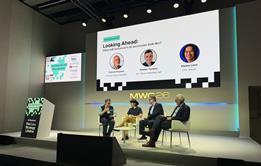
Hosted by TelcoTitans and sponsored by Wavelo: four panels examining the telecom industry’s readiness for AI
- 1
- 2
 Currently
reading
Currently
reading
OSS/BSS Data Strategies for AI Success — Data-Driven Telco Summit 2026, Panel Discussion 2 video
- 4
- 5